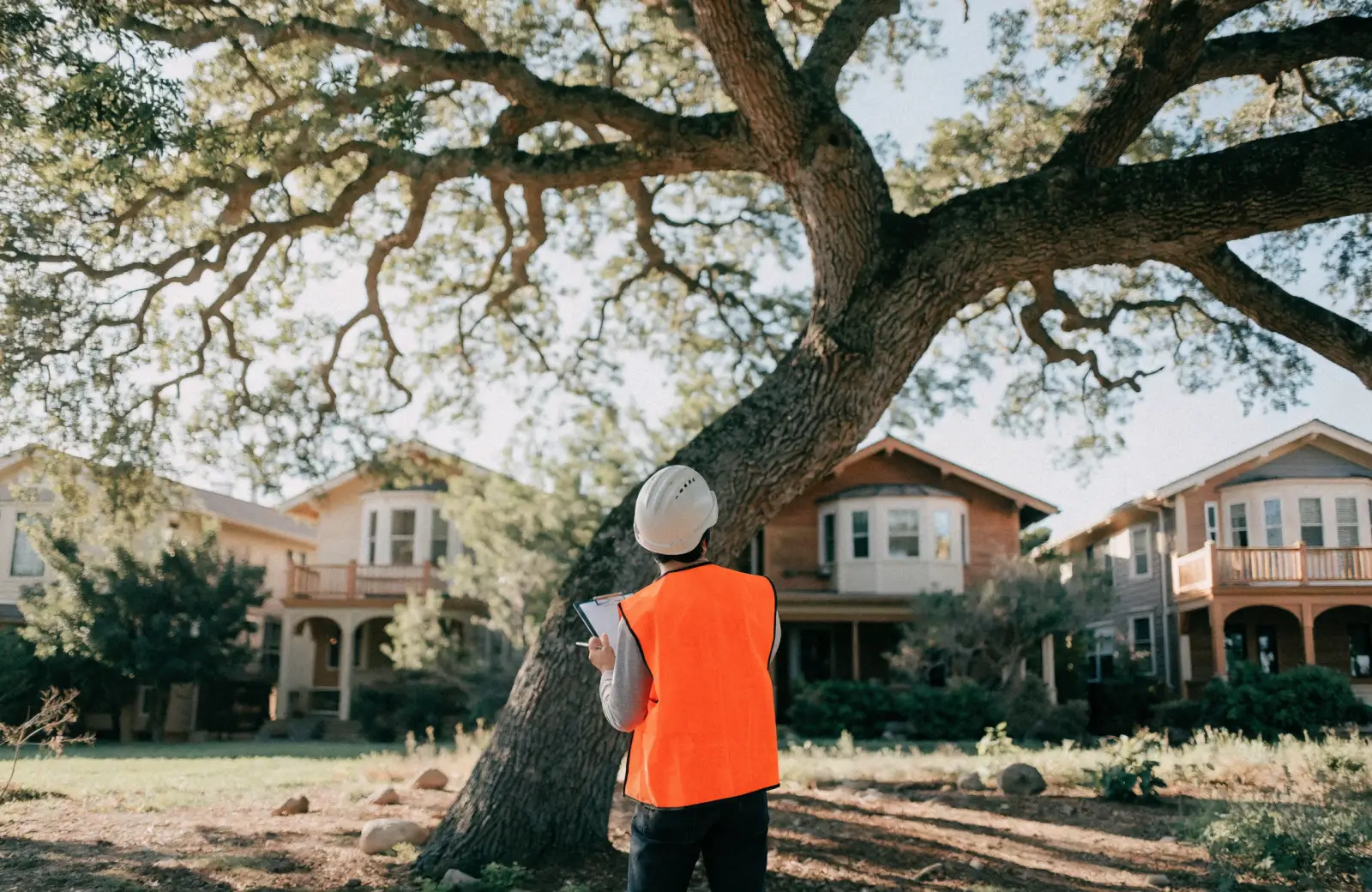
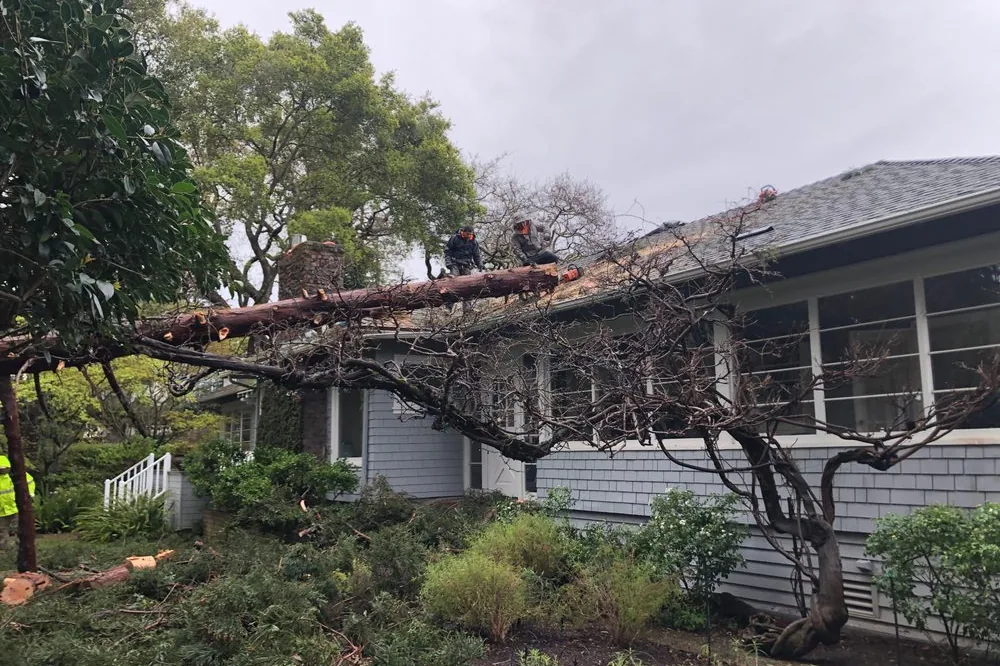
Get your trees ready for storm season in October and November, while the ground is dry and crews and city permits still move at their normal pace. This is our plain-language checklist for Peninsula homes: what to look at, who to call about what, and what can safely wait until spring.
We are a firefighter-owned tree crew in Redwood City, and the weather records make the case for fall prep better than we can. Of the 310 wind events the National Weather Service logged for San Mateo County and the Peninsula forecast zones from January 2014 through June 2026, 223 (72 percent) landed in December, January or February. October had 8. On October 8, 2026, NOAA’s Climate Prediction Center kept its El Niño Advisory in place and called a strong to very strong El Niño likely through early 2027.
When we say storm prep, we mean both the big calls, like a cracked limb hanging over a bedroom, and the small ones, like parking the car somewhere else on a windy night. It covers the tree in your backyard, the street tree in the planting strip, and the neighbor’s oak that leans over your fence.
If you have lived under the same big tree for 20 years, you may have stopped seeing it. If you just bought a house with mature trees, you inherited decisions nobody walked you through. And if you are checking a parent’s yard before the rains, you want a short list you can finish in one visit.
By the end you will have a 15-minute walk-around, a clear answer on who owns each tree and each wire, and a printable checklist for the fridge. We cover it in four parts: why the calendar matters, what to look for, who handles what, and what to do the week a storm is forecast. Start with the calendar, because it is the reason October beats January.
Why October Is the Month to Prep Peninsula Trees for Storms
October is the right month because Peninsula wind storms are seasonal, and this is the quiet end of the season. The windiest stretch runs December through February, and the things that make tree work easy (dry ground, open crew calendars, normal permit timelines) get scarce once it starts.
The storm reports break down like this by month. We counted every Strong Wind, High Wind and Thunderstorm Wind event in the NOAA Storm Events Database for San Mateo County and three National Weather Service forecast zones (San Francisco Peninsula Coast, San Francisco Bay Shoreline and the Santa Cruz Mountains), January 2014 through June 2026.
| Month | Wind events logged | Event reports that name a tree |
|---|---|---|
| October | 8 | 3 |
| November | 22 | 5 |
| December | 49 | 35 |
| January | 85 | 41 |
| February | 89 | 51 |
| March | 23 | 7 |
| April | 18 | 13 |
| May through September | 16 | 3 |
| Total | 310 | 158 |
Of the 158 reports that name a tree, 127 fell in December, January or February. That is the window your trees need to be ready for.
El Niño raises the stakes without settling them. NOAA’s own explainer says the link between El Niño and a wetter winter is weaker over California than elsewhere and depends on how strong the event is. A strong one tilts the odds. It does not promise a soggy winter, and a drier year can still bring one bad wind night.
A few practical reasons make October better than January:
- Permits take time. Redwood City says most tree permits take about 10 working days, and non-emergency applications submitted as emergencies do not get priority.
- The ground gets soaked. The USDA Forest Service warns that trees with root problems may blow over in wind storms. Winter rain is when a weak root plate gets tested.
- You get to pick the day. We charge nothing extra for emergency removals, so price is not the reason to move early. The reason is that a planned removal happens on a dry day you pick, while a storm removal happens after the tree has picked your roof.
Picture a homeowner in the Farm Hill neighborhood with a 60-foot pine over the driveway and a dead limb they keep meaning to deal with. In October that limb is a one-visit pruning job on a dry morning. In January it is a 2 a.m. phone call, a car under a branch and a wait while every crew on the Peninsula works the same storm.
The 15-Minute Walk-Around: What to Look For
Walk every tree that could reach your house, driveway, play area, street or a wire, and look for the seven defects the USDA Forest Service names: dead wood, cracks, weak branch unions, decay, cankers, root problems and poor tree architecture. A defect only matters when something sits in reach. In the agency’s words, a tree with defects is not hazardous unless part of it is “within striking distance of a target.”
If you just moved into a house with mature trees, this walk is also how you learn what you own. Start by deciding which trees count. As a working rule, assume a tree can hit anything within a distance about equal to its height. Then walk each one slowly, look up into the canopy and down at the base, and check for:
- Dead branches or a dead top. The Forest Service calls dead wood “not negotiable.” It is brittle and cannot bend in the wind.
- Hangers, meaning broken branches caught in the canopy and waiting for the next gust.
- Cracks that run deep through the bark and into the wood.
- Two trunks growing from one point with bark pinched between them. That is a weak branch union, and the Forest Service treats a cracked one as a serious defect.
- Mushrooms, conks, or soft or hollow wood at the base, which point to decay. Our guide to signs a tree needs removal shows what each one looks like.
- A new lean with soil lifting, cracking or mounding on one side. The Forest Service flags a leaning tree with recent root exposure or soil movement as a serious defect.
- Roots cut by a trench, a new driveway or a sewer job. A tree that has lost more than half the roots under its crown has lost its support.
- Limbs resting on the roof, the gutters or the wire to the house.
What you find decides the next step. If you find a defect with a target underneath, book an in-person look this month; our guide on when you need a certified arborist in Redwood City explains what that visit should cover. If you find a defect with nothing in reach, note it and schedule the work for a dry spell. If you find nothing, take dated photos of each tree for your records and walk the yard again after the first big storm.
Height alone is not on that list. A tall, healthy redwood swaying in a gust is doing what trees do, and taking it down because it looks frightening at night trades a shade tree for peace of mind you could get from an inspection.
Say you are checking your mom’s house in San Carlos before Thanksgiving. You find a dead limb, about as thick as your forearm, over the spot where she parks, and nothing else of note. That is not an emergency. It is a single pruning job to book before December, plus a reminder to park on the street on windy nights until it is done.
Who Handles What: Power Lines, Street Trees and the Neighbor’s Oak
Who handles a tree depends on what it touches and where it stands. PG&E manages trees near its power lines, the city manages street trees in the planting strip, and you are responsible for trees on your property and for keeping the wire from the pole to your house clear. Your neighbor owns their tree, though you can usually trim what crosses your line.
Branches near power lines
PG&E’s rule for homeowners is short: keep people and tools at least 10 feet away from power lines, and leave tree work near lines to line clearance qualified crews. The split that surprises people is the service drop, the wire that runs from the pole to your house. PG&E says property owners are responsible for keeping it clear of vegetation, and it will disconnect that line for free so the work can be done safely.
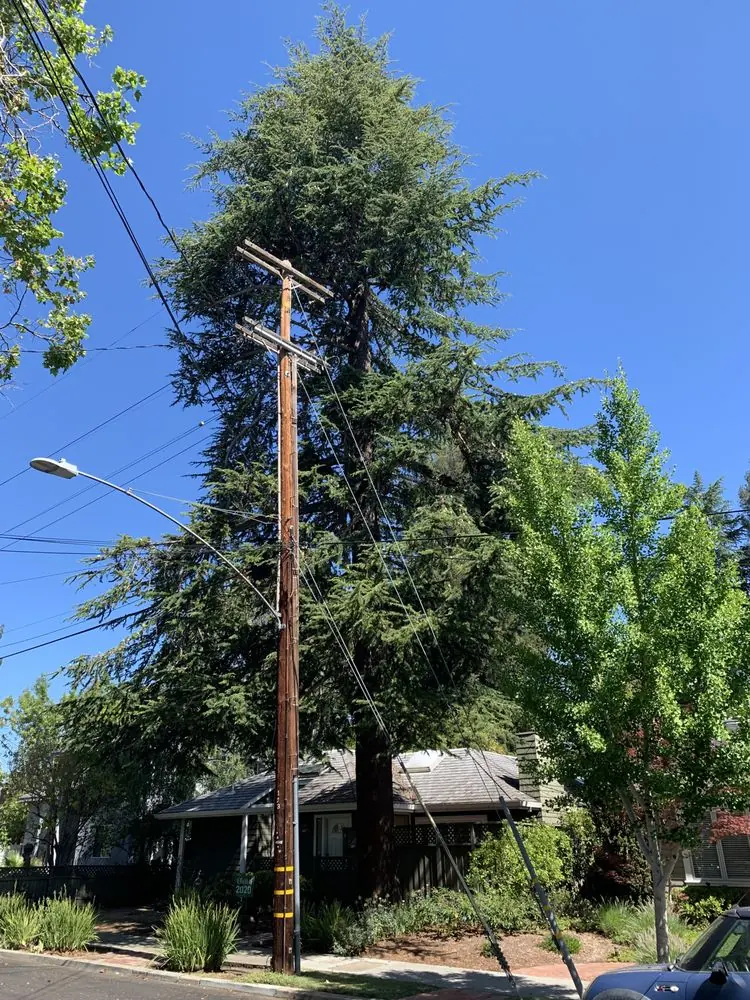
If a branch is on the lines between poles, report it to PG&E at 1-800-743-5000, or call 911 if it is an emergency. If branches touch the wire to your house, ask PG&E for the free temporary disconnect before anyone, including us, works near it. A tree on a live line is never a do-it-yourself job; our guide to tree emergencies covers what to do in that moment.
Picture a house in Emerald Hills where the service drop runs straight through an oak canopy. Every winter the branches saw at the wire. In October that is a scheduled disconnect and a morning of pruning. After a storm it can be a dead outlet, a sagging line and a long wait.
Street trees and the planting strip
In Redwood City, most trees in the strip between the street and the sidewalk belong to the city, and Public Works maintains them, according to the city’s tree FAQ. If one worries you, call the city arborist at 650-780-7464 during business hours. If a city tree or branch has fallen and is threatening life or property, call 911. If you want a street tree pruned sooner than the city’s schedule, the city lets you get a permit and hire a company to prune it to city standards.
The neighbor’s tree over your roof
Redwood City says you can trim branches and roots that cross onto your property back to the property line without a permit, as long as the cut does not kill or seriously damage the tree, and it recommends telling your neighbor first. For anything bigger, and for who pays if it falls, see our guide to neighbor tree branches and California law.
The permit clock
Redwood City requires a permit to prune or remove any tree more than 38 inches around, measured at the trunk’s largest point between 6 and 36 inches above the ground. That applies to dead trees too. There is no fee, and the city says most permits take about 10 working days, with real emergencies often answered the same day. If your trunk measures under 38 inches, you can schedule the work without a city permit. If it measures over, file in October. Our Redwood City tree permit guide walks through the application, and other Peninsula cities set their own rules.
What to Fix Now and What Can Wait
Fix anything with a defect over a target before December, and leave everything else for a dry day. In most yards that means pruning out dead wood and hangers, shortening a long limb over the roof, and removing a whole tree only when the problem cannot be pruned out.
| What you found | Something in reach? | What usually makes sense | When |
|---|---|---|---|
| Dead branch or hanger | Yes | Remove the dead wood | Before December |
| Dead tree | Yes | Removal, with a permit if 38 inches or more around | File the permit now |
| Crack or pinched double trunk | Yes | In-person look, then prune or remove | October or November |
| New lean with soil lifting | Yes | Treat as urgent and call | Now |
| Limbs on the wire to the house | Yes | PG&E disconnect, then clear | Before December |
| Any defect | No | Note it and keep watching | Next dry spell |
| Tall, sound tree | Either | Nothing, and do not top it | None |
Two shortcuts are worth skipping. Topping, cutting a tree’s main stems back to stubs, is discouraged across the tree care industry, as Redwood City’s own FAQ notes. And the Forest Service says cabling and bracing does not repair a hazard tree; it only recommends it for trees with significant historic or landscape value.
The cheapest fix is often moving what sits under the tree. The Forest Service calls removing the target “an inexpensive and effective” way to deal with a hazard tree.
Say your family has a trampoline and a second car under a big eucalyptus that you plan to have looked at in November. Moving the trampoline to the other side of the yard and parking the car on the street costs nothing, takes 20 minutes and protects both until the inspection happens.
If you have owned your home for decades and nobody has looked up into those trees in years, here is the order we would work in:
- Walk the yard this weekend with the printable checklist below and photograph every tree that could reach something.
- Measure any trunk you might prune or remove; in Redwood City, more than 38 inches around means filing a permit in October.
- Book an in-person look for anything with a defect over a target, and ask PG&E for a disconnect if limbs touch the wire to the house.
- Move what you can out from under the trees you are still watching.
The Week a Storm Is in the Forecast
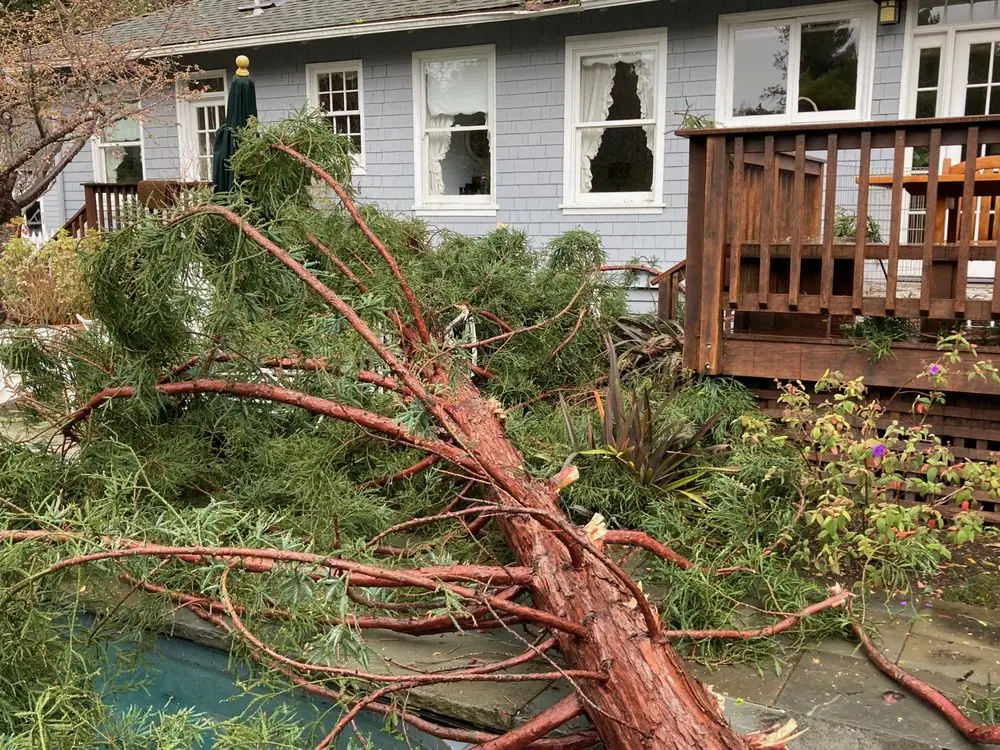
When a storm is a few days out, the job is moving targets and documenting, not tree work. Move cars out from under big limbs, bring in or tie down anything a gust can throw, take dated photos of your trees and roof, and save the phone numbers you will need.
- Move cars, trailers, patio furniture and play sets out from under big limbs.
- Clear gutters and street drains so storm water runs off instead of pooling in the yard.
- Photograph everything. Dated photos of each tree, the roof and the yard make an insurance claim easier if something comes down. Our post on emergency tree removal cost and insurance explains how claims usually work.
- Skip the last-minute pruning. Ladders and saws in gusty weather are how people get hurt, and a rushed cut rarely fixes the real problem.
- Save the numbers: 911 for anything on a power line or threatening a person or home, PG&E at 1-800-743-5000, the Redwood City arborist at 650-780-7464, and Firefighter Tree Service at (650) 454-0373.
If a tree does come down, our 24-hour emergency tree removal page covers what happens next. Do the October work, though, and the payoff is a winter where a storm warning means bringing in the patio chairs, not lying awake listening to the tree over the bedroom.
Your Printable Storm Prep Checklist
Print this, tape it inside a kitchen cabinet and work through it in October.
Peninsula Tree Storm Prep Checklist
October: the walk-around
- List every tree that could reach the house, driveway, play area, street or a wire
- Look for dead branches, a dead top and hangers caught in the canopy
- Look for cracks into the wood and double trunks with bark pinched between them
- Check the base for mushrooms, conks, soft or hollow wood
- Check for a new lean, soil lifting or cracking, and roots cut by recent digging
- Check for limbs on the roof, gutters or the wire to the house
- Take dated photos of every tree and the roof
Before December: the fixes
- Book an in-person look at any defect with something underneath it
- Measure trunks: over 38 inches around in Redwood City means file a permit now
- Ask PG&E for a free disconnect if branches touch the wire to the house
- Call the city about street trees in the planting strip
- Move play sets, trailers and parked cars out from under trees you are watching
Storm week
- Park away from big limbs and secure anything the wind can throw
- Clear gutters and drains
- Skip last-minute pruning and ladders
Numbers to keep: 911 for lines down or danger to people or homes. PG&E 1-800-743-5000. Redwood City arborist 650-780-7464. Firefighter Tree Service (650) 454-0373.
Frequently Asked Questions
When should I get my trees ready for storm season on the Peninsula?
October and November. Of the 310 wind events the National Weather Service logged for San Mateo County and the Peninsula forecast zones from January 2014 through June 2026, 223 hit in December, January or February, and only 8 came in October. Working on dry ground in the fall also leaves time for a city permit, which Redwood City says takes about 10 working days.
How can I tell if a tree might fall in a storm?
Look for the seven defects the USDA Forest Service lists: dead wood, cracks, weak branch unions, decay, cankers, root problems and poor tree architecture. Then check what the tree could hit. A defect only becomes a hazard when part of the tree is within striking distance of a house, a car, a street, a play area or a wire. A new lean with soil lifting at the base is the sign to treat as urgent.
Do I need a permit to remove a dead tree in Redwood City before winter?
Yes, if the trunk measures more than 38 inches around at its largest point between 6 and 36 inches above the ground. Redwood City requires a permit to prune or remove those trees even when they are dead. There is no fee, and most permits take about 10 working days, so file in October rather than the week a storm is forecast.
Who trims branches near the power line to my house?
PG&E manages trees near its lines, but the property owner is responsible for keeping the service drop, the wire from the pole to the house, clear of vegetation. PG&E will disconnect that line for free so the work can be done safely, and it says only line clearance qualified workers should do tree work near power lines. Keep people and tools at least 10 feet away.
Does a strong El Niño mean a bad storm year for Bay Area trees?
Not necessarily. On October 8, 2026, NOAA’s Climate Prediction Center said a strong to very strong El Niño is likely through early 2027, but NOAA also notes the link between El Niño and a wetter California winter is weaker than elsewhere and depends on the event’s strength. Treat it as a reason to check your trees, not a forecast that a specific tree will fail.
Should I cut down a tall tree before storm season just to be safe?
Not because of height alone. A tall, sound tree moving in the wind is doing what trees do. Removal makes sense when a defect such as a crack, decay, a dead top or a lifting root plate sits over something it could hit, and the defect cannot be pruned out. If you are unsure, have the tree looked at in person before you decide.
Get Your Trees Storm-Ready With Firefighter Tree Service
If your walk-around turned up a dead limb over the roof, a fresh lean or branches on the wire to the house, call us at (650) 454-0373 and we can take a look before the rains. Removals start at $1,000 per tree and we charge nothing extra for emergency removals, so acting now is about choosing the day, not dodging a surcharge. See what a hazardous tree removal visit with our crew covers.