Emergency tree removal on the Peninsula usually costs $1,000 to $5,000 per tree at companies that charge an emergency premium, roughly 1.5 to 3 times what the same tree costs on a scheduled day. A large tree lying on a house that needs a crane after dark can pass $8,000. Firefighter Tree Service has no emergency premium and no after-hours price. Our removals start at $1,000 per tree and trimming starts at $300, whether you call at 2 a.m. in January or at noon on a Tuesday.
| Emergency work | Firefighter Tree Service | Typical quote at other Bay Area companies |
|---|---|---|
| Tree removal | From $1,000 per tree, same price day or night | $1,000 to $5,000+ per tree, often 1.5 to 3x the scheduled price |
| Hanging or broken limb (trimming) | From $300 | Callout minimum plus hourly rate |
| After-hours, weekend or storm callout | $0 | Often $500 to $1,500 before the first cut |
Want a number for your exact tree? Try our tree removal cost calculator. An emergency removal is priced exactly like a scheduled one.
What Counts as a Tree Emergency
A tree emergency means a tree or large limb is on a structure, a vehicle or a power line, is blocking your only access, or is visibly failing with something or someone underneath it. Everything else, including most leaning trees that have looked that way for years, can usually wait for a scheduled appointment.
At companies that charge a premium, this line is the single biggest lever on your bill. We take 2 a.m. calls from homeowners who need a crew on site tonight, and we also take them from people whose tree has been leaning the same way since they bought the house. If you are staring at a tree right now and not sure which one you are, our guide on when to call an emergency arborist walks through the five situations that need a crew tonight. When in doubt about an active hazard, call. A phone assessment costs nothing, and because our price does not change after dark, the only question is what is safest for your property.
Average Emergency Tree Removal Cost by Situation
The average emergency tree removal cost at Bay Area companies that charge a premium falls between $1,000 and $5,000, and what the tree is resting on matters more than its height. For comparison, a standard scheduled tree removal here runs $600 to $2,000. Our own tree removal in Redwood City starts at $1,000 per tree, emergency or not. The table shows what the wider market quotes so you can judge the numbers you hear on a storm night.
| Emergency scenario | Typical quote at companies that charge a storm premium |
|---|---|
| Large limb down, blocking driveway or yard, daytime | $600 to $1,200 |
| Whole tree down in yard, no structure contact | $1,000 to $2,500 |
| Tree on roof, fence or vehicle, standard access | $2,500 to $5,000 |
| Large tree on structure, crane required, after hours | $4,000 to $8,000+ |
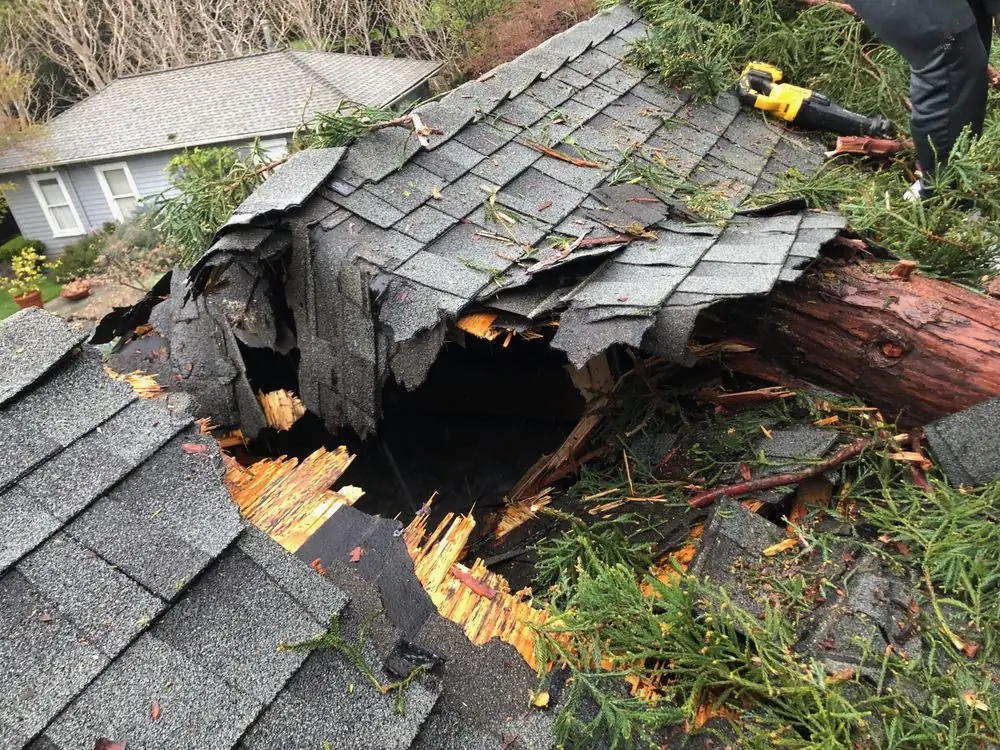
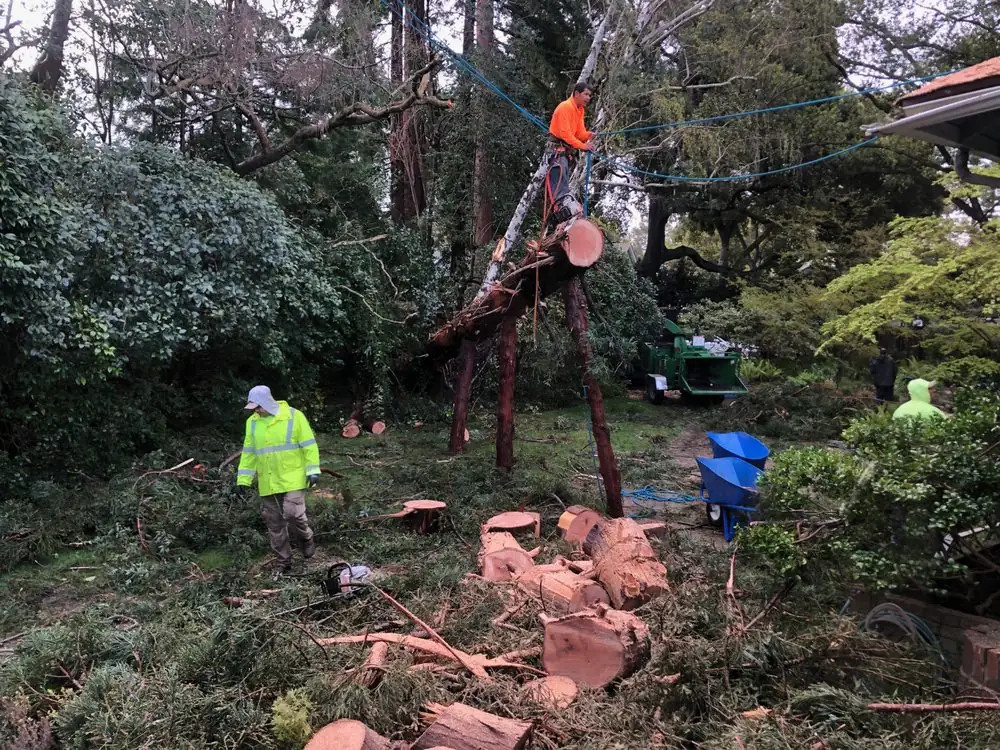
A 30-foot tree costs far less to take down than an 80-foot one, but a tree resting on a house is a harder job than the same tree standing in the yard. It is under load, and every cut changes where that weight goes. That calls for rigging, which is what drives the price up and why a tree resting on anything is not a weekend chainsaw job.
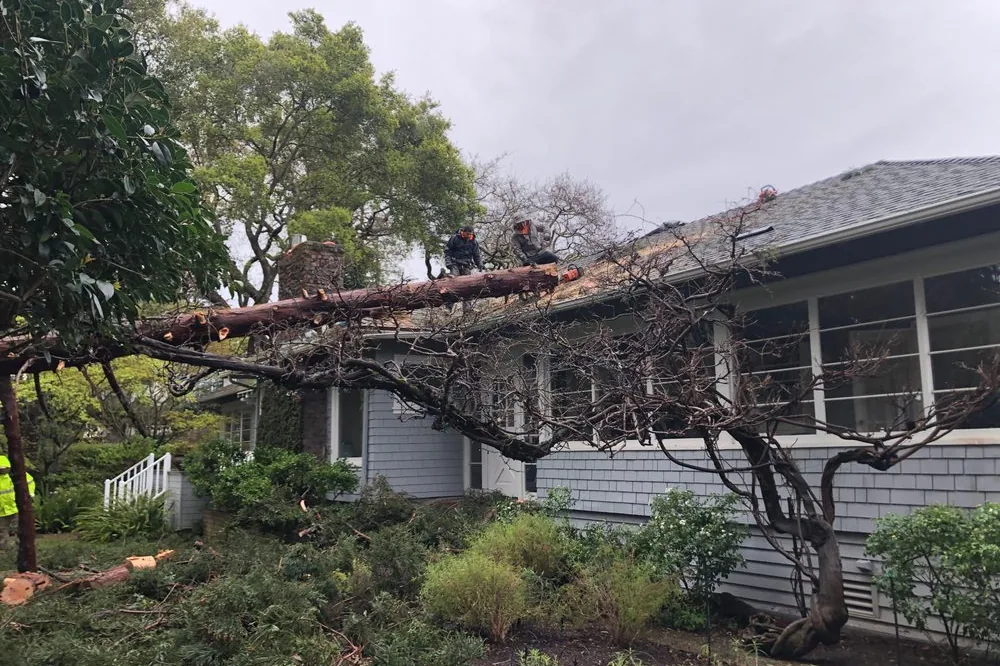
Say a 40-foot Monterey pine snaps at the trunk in a January storm and lands across an Emerald Hills driveway, touching the car but not the house. One company quotes $3,800 that night, built from a callout fee, an after-hours rate and crane time. The same tree on a scheduled weekday would be a single removal at the normal price. That gap is the storm premium, and it is the number to ask about before anyone starts a saw.
If you were quoted $8,000 for a big oak across your roof, homeowners around the country report $6,000 to $9,000 for that job at companies that charge a premium. A high quote can be fair. Ask for a breakdown, and be wary of a quote that has none.
Why Some Companies Charge a Storm Premium
Where companies charge an emergency premium, it covers three real costs: after-hours crew mobilization, equipment dispatched on no notice, and the added risk of working a loaded, unstable tree. A scheduled removal is planned around daylight, weather and equipment availability, and an emergency removal can’t wait for any of them.
Here is where that money goes at most companies:
- Crew callout. Getting a crew out of bed and onto your property at 2 a.m. means overtime pay and a callout minimum, typically $500 to $1,500 before a single cut.
- Equipment on no notice. Crane mobilization alone can add $1,500 to $3,000 when it has to happen today instead of next Tuesday.
- Working a loaded tree. A tree lying on a roof holds tension and compression in ways a standing tree never does. Cutting it wrong sends thousands of pounds through your living room. Slower, rigged, piece by piece dismantling is safer and costs more.
You often do not need the whole job done at 2 a.m. In many cases the right move is a make-safe visit tonight, stabilizing or removing the immediate hazard, then finishing the removal and cleanup in daylight. We are a firefighter-owned company, and this is how fire crews think: control the hazard first, then work the scene methodically. Any company that insists the entire removal must happen tonight, at tonight’s rates, is selling urgency you may not need.
We charge the same price for the job whatever time you call. There is no surcharge or storm rate. If the fix is pruning out a broken or hanging limb instead of taking the tree down, that is trimming work, and our trimming starts at $300. Our guide to tree trimming costs in the Bay Area explains how crews price that work. A customer whose house took two redwoods in the March 2023 storms put it this way in a Yelp review:
“Our insurance agent was amazed at their very reasonable price, calling it the lowest he’d seen in the area for this type of work.”
Pete F., Yelp review
When Storm Emergencies Happen on the Peninsula
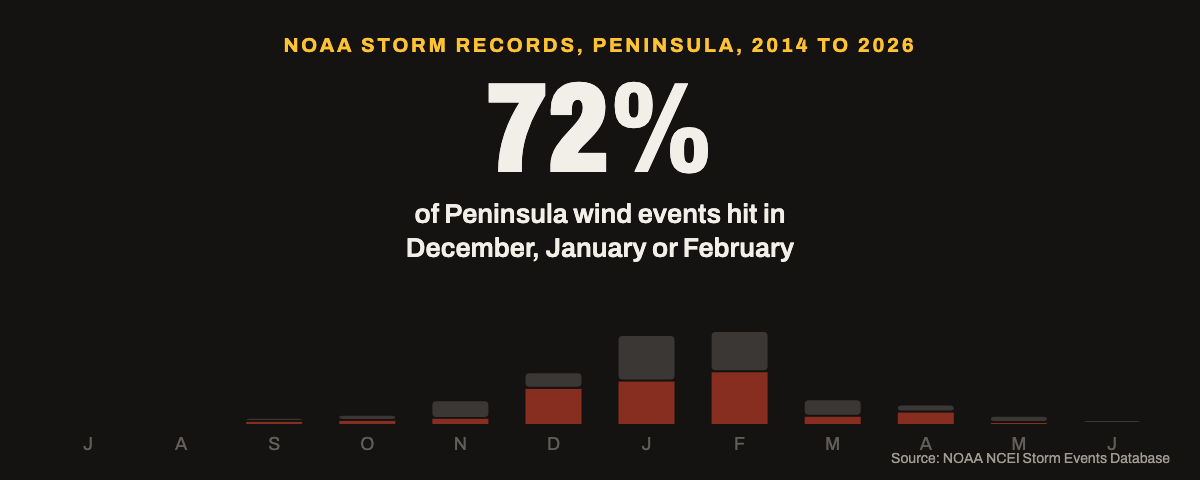
Most Peninsula tree emergencies arrive between December and February. Of the 310 wind events the National Weather Service logged for San Mateo County and the Peninsula forecast zones from January 2014 through June 2026, 223 (72 percent) landed in those three months, and only 8 came in October. We mapped every one of them, month by month, in 12 years of Peninsula storm records.
When a big storm hits after days of rain, saturated soil loosens root plates, so more whole trees go over instead of single limbs. Every crew’s phone also rings at once. At companies with surge pricing, that is the night quotes jump. Our price stays the same. What changes for us is the order of the work: real hazards to people and houses go first.
Our storm prep tree checklist for Peninsula homes walks through what to check in October and November, while the ground is dry and crews still have open calendars.
Does Homeowners Insurance Cover Tree Removal in California?
Homeowners insurance usually covers tree removal when a covered peril, like wind or lightning, knocks the tree onto an insured structure such as your house, garage or fence. The California Department of Insurance says damage from fallen trees is generally covered under standard homeowners policies, with exceptions, so read your own policy. If the tree fell in the yard and hit nothing, most policies pay nothing toward removal.
Removal coverage has a cap. According to the Insurance Information Institute, when a tree hits an insured structure, the policy covers removing it generally up to about $500 to $1,000, depending on the insurer and the type of policy. Some policies apply that limit per storm rather than per tree, so three trees down in one night may share a single cap. The roof repair is a separate, much larger part of the claim; the tree removal line item is small. Plan for the gap between your removal invoice and that cap.
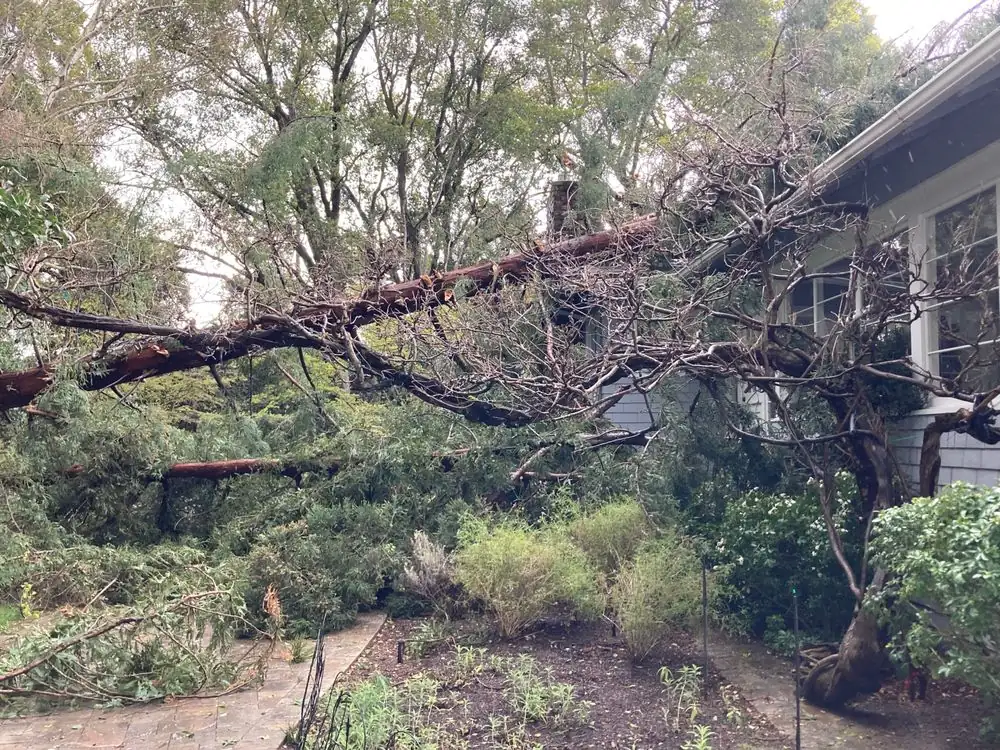
What your insurance does depends on where the tree landed:
- If it hit your house, garage or fence: file a claim. Expect the structure damage to be covered and the removal to be paid up to the policy cap, minus your deductible.
- If it hit nothing: removal is generally on you. The exception some insurers make is a tree blocking your driveway or a ramp built for a person with a disability.
- If it landed on your car: that goes to your auto policy, under comprehensive coverage, if you carry it. Your homeowners insurer may decline the part of the bill tied to the car.
- If the tree was dead or neglected: poor maintenance is not a covered cause, and an insurer can push back on a tree that was obviously failing before the storm.
Picture two houses on the same Redwood City street after the same storm. At one, an oak limb punches through the garage roof; the owner files, the adjuster pays for the garage, and the removal is covered up to about $1,000. Across the street, an identical limb lands flat on the lawn. That owner pays for the removal, because the policy protects structures, not yards.
Insurance never pays for preventive removal. If your insurer flags a hazardous tree during an inspection, they may require you to remove it at your own cost, and taking a dying tree down on a schedule is far cheaper than pulling it off your roof later.
How to File the Claim Without Slowing Down the Removal
You do not need to wait for an adjuster to make your property safe. The California Department of Insurance tells storm-hit homeowners to make temporary repairs to prevent further damage, to take pictures and keep records of all cleanup and repair costs, and to hold off on permanent repairs until the adjuster sees the damage. Getting a tree off your roof is a temporary repair; rebuilding the roof is not.
Do it in this order:
- Photograph everything before any cutting starts. The tree on the structure, the point of failure, the damage, wide shots and close-ups. Two minutes of phone photos is what your claim gets paid on.
- Authorize the make-safe work. Securing the scene and stopping further damage is expected of you, and getting a tree’s weight off a roof before the next rain is exactly that.
- Get the price in writing first, and ask for an itemized invoice. Make-safe work, full removal and debris hauling should be separate line items. Some policies only pay for the part of the tree touching the house, so the split tells the adjuster exactly what to cover.
- Report the claim promptly and keep a claim diary. Write down every call with your insurer. If the adjuster says something is excluded or limited, the Department advises asking them to point to the exact policy provision.
Say a crew arrives at 7 a.m. and finds a fir lying across your roof and half the backyard. A clean invoice reads: make-safe removal of the section on the house, then removal of the trunk from the yard, then hauling. Your insurer pays the first line up to the cap, and you know exactly what the rest costs before you agree to it. A single line that reads “storm cleanup, $7,000” is the invoice adjusters push back on.
Read anything a storm crew asks you to sign. Some contractors ask you to let them bill your insurer directly, and once you sign that kind of form you may never see the invoice until it is a dispute. Get the price first, in writing.
Stump grinding is rarely part of an insurance payout, so treat the stump as a separate decision once the house is safe.
If this is your first claim, do not let the process push you into delay. A tree on your roof gets worse with every hour of wind and rain, and no reasonable adjuster expects you to leave it there.
Who Pays When a Neighbor’s Tree Falls on Your House
If your neighbor’s tree falls on your house, your own homeowners policy handles the damage and removal, not theirs. It can feel backwards. You are insured no matter who owns the tree, so your insurer pays your claim, and if the neighbor was negligent, for example they ignored written warnings about a dead tree, your insurer may recover from their policy and refund your deductible.
Fault only enters the picture when negligence can be shown, so if a neighbor’s tree worries you, put it in writing before it fails. California law is specific about who owns what and who owes what, and we broke it down in plain English in our guide to neighbor trees and overhanging branches under California law. If you live next to a tree you are worried about, read it before the storm.
Power Lines and Night Calls
If the tree is touching a power line, nobody works it until the utility clears it. Stay far away, keep everyone out of the area, and call 911, then PG&E at 1-800-743-5000. PG&E’s electric safety guidance says to always assume a downed line is live, and never touch anything in contact with it, including the tree. No tree crew, ours included, touches an energized tree, and any company willing to is one you should hang up on.
Outside of power lines, when you call a true 24-hour tree service at 2 a.m., you should reach a person, get a phone assessment, and hear a firm plan for tonight. From many companies you get voicemail and a callback at 8 a.m. instead, because many companies advertise 24-hour service with no one actually on call.
We run emergency tree removal in Redwood City and across the Peninsula the way a fire crew runs a call. Someone answers, the truck is stocked before the storm hits, and the first thing we do on scene is make it safe.
How to Avoid an Emergency Removal
Most tree failures show warning signs months in advance. Dead limbs, fungus at the base, cracks where branches meet the trunk, and soil lifting on one side are all warnings you can act on while the price and the schedule are yours to choose.
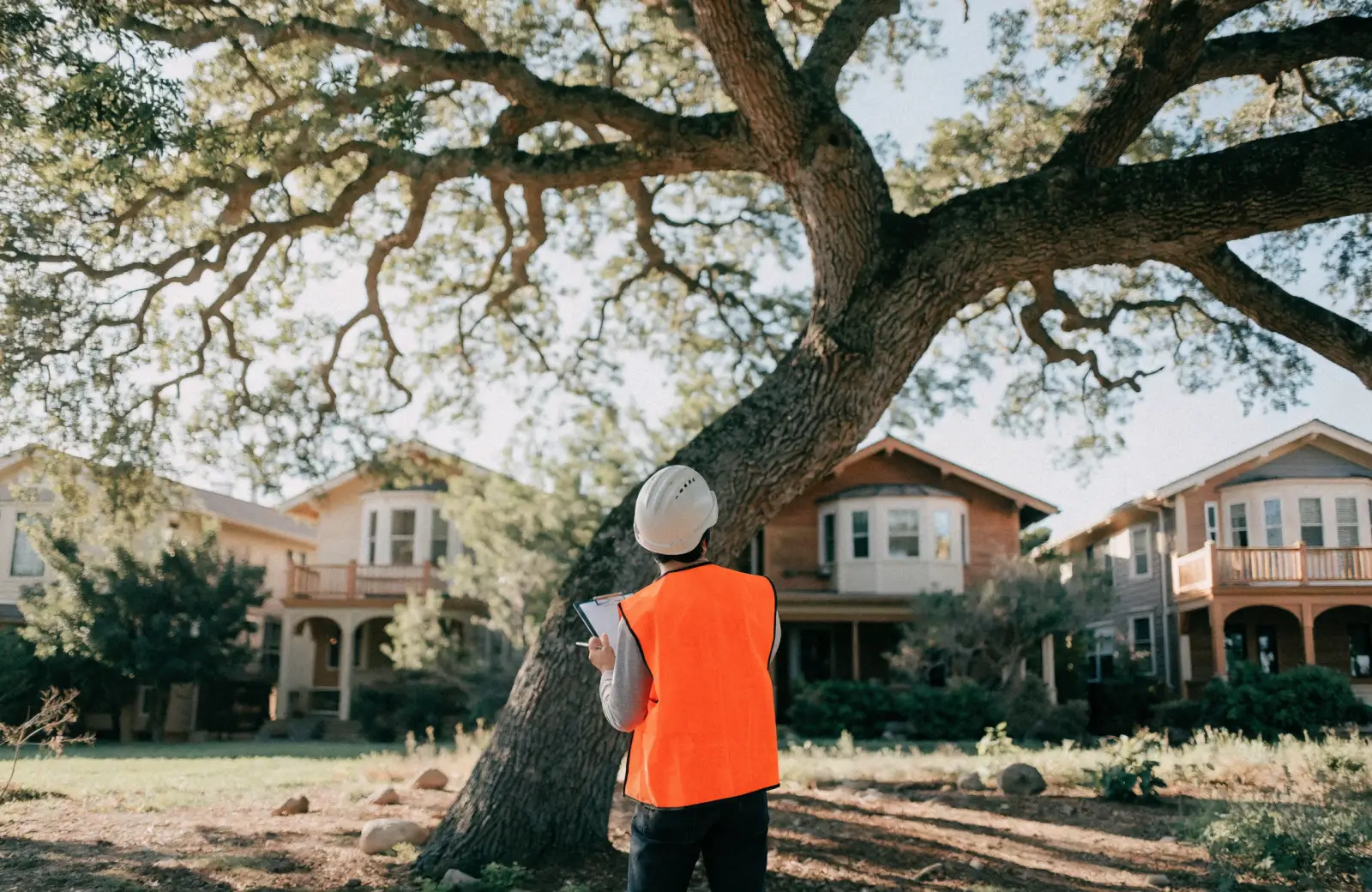
If you have owned your home for years and cannot remember the last time anyone looked at your big trees, have them checked. If you just bought a house with mature trees, you inherited decisions nobody walked you through. After 500+ residential properties across the Peninsula, what we see is that the trees that end up on roofs are almost never the ones someone was watching. A tree health inspection before storm season tells you what needs pruning, what needs watching and what should come down on your schedule.
Frequently Asked Questions
How much does emergency tree removal cost on the Peninsula?
At companies that add an emergency premium, the average emergency removal on the Peninsula lands between $1,000 and $5,000 per tree, and a large tree on a house that needs a crane after dark can pass $8,000. Firefighter Tree Service charges no emergency premium: removals start at $1,000 per tree and trimming starts at $300, the same price at 2 a.m. as on a Tuesday afternoon.
What is considered emergency tree removal?
A tree emergency is a tree or large limb on a house, a car or a power line, a tree blocking your only way in or out, or a tree that is visibly failing over people or a structure. A tree that has leaned the same way for years, or a limb lying in an open yard, can usually wait for a scheduled visit.
Does homeowners insurance cover tree removal after a storm in California?
Usually, when the storm knocked the tree onto an insured structure such as your house, garage or fence. The California Department of Insurance says damage from fallen trees is generally covered under standard homeowners policies, with exceptions, and the Insurance Information Institute puts the removal portion at about $500 to $1,000, depending on the insurer and the policy. Your deductible still applies.
Will insurance pay to remove a tree that fell and hit nothing?
Generally no. If the tree did not hit an insured structure, there is usually no coverage for removing it. Some insurers will pay to remove a fallen tree that blocks your driveway or a ramp built for a person with a disability, so check your policy before you assume the cost is yours.
Who pays if my neighbor’s tree falls on my house?
Your own homeowners policy. You file with your insurer no matter who owned the tree. If the neighbor was negligent, for example they ignored a dead tree, your insurer may recover the money from the neighbor’s insurer and you may get your deductible back.
Does Firefighter Tree Service charge more at night, on weekends or during a storm?
No. We have no emergency premium and no after-hours price. A removal costs what the same removal would cost on a scheduled weekday, starting at $1,000 per tree, and trimming starts at $300.
Call Firefighter Tree Service Any Hour
We handle emergencies the way a fire crew would: make it safe first, tell you straight what has to happen tonight and what can wait for daylight, and charge one price whether it is 2 a.m. or 2 p.m. Our ISA-certified, firefighter-owned crew handles 24-hour emergency tree removal across Redwood City, the Peninsula and the South Bay, starting at $1,000 per tree. Call 650-454-0373 any hour.