
A tree becomes an emergency the moment it, or a large piece of it, lands on a structure, a vehicle, a person, or a power line, or starts actively failing with something it could hit underneath. That is the whole test. Everything else, including most trees that have leaned the same way since you bought the house, can wait for a scheduled visit at normal rates.
We are a firefighter-owned crew, so the first question we ask on every storm call is the same one we asked on engine crews: is there a target, and is the hazard moving right now. If you are standing in your yard at 2 a.m. with a flashlight, wondering whether the cracking sound you just heard means you should call someone, this guide sorts the genuine emergencies from the situations that only feel like one. Both matter, and knowing the difference can save you a property claim, an injury, or an after-hours bill you did not need.
What Counts as a Tree Emergency?
A tree emergency is any situation where a tree or a large limb threatens people, a building, a vehicle, or a power line, or where the tree is visibly failing and something valuable sits in its fall path. The trigger is not how frightening the tree looks. It is whether there is a target and whether the failure is active right now.
A dead oak in the back corner of an empty lot is a problem to schedule. The same oak leaning fresh over your bedroom after a windstorm is an emergency. If you have owned your home for years and cannot remember the last time anyone looked at your big trees, a sudden change is the signal to act. If you are a first-time homeowner facing this for the first time, know that panic is not the test, and a certified arborist can usually tell you which situation you have in a two-minute phone call.
Call Right Now: Emergencies That Can’t Wait
Call for emergency service immediately if any of the situations below is true. These are the cases where hours matter and where the wrong move gets someone hurt. In each one, your job is to keep people back and let a trained crew handle the tree.
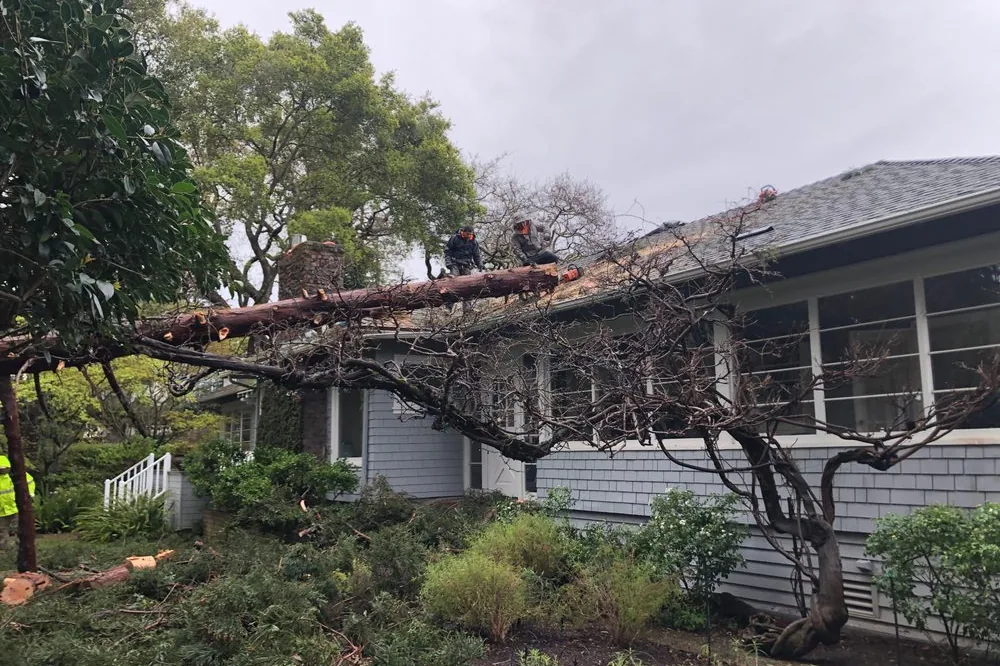
A tree or limb is on your house, car, or garage. A tree on a structure compromises the roof, invites water in, and keeps shifting. Do get everyone out of that part of the house, call 911 if anyone is hurt or trapped, then call an emergency tree removal crew to stabilize and tarp. Do not climb on the roof or cut anything under load, because a tree resting on a structure is holding tension and every cut changes where thousands of pounds go next.
A tree or branch is touching a power line. This is the one people get most wrong, so it has its own section below. For now: stay back, treat the line as live, and call 911 and PG&E at 1-800-743-5000 before you call anyone else.
A tree started leaning, or its roots lifted, after a storm. A lean that appeared overnight means the root plate is letting go. In the Bay Area this is the leading cause of whole-tree failure, because our clay soils hold water and a saturated root plate combined with wind is often all it takes. UC’s Master Gardeners put it plainly: when the soil is saturated and the wind picks up, the tree may fail. Do stay outside a circle at least as wide as the tree is tall, and look for cracked or heaving soil at the base. Do not prop it with boards or straps, and do not assume it will settle back into place.
After the Peninsula’s saturating winter rains, we get calls for trees that have started to lift at the base as the soil loses its grip. Storm response is core to what we do. If you would rather get ahead of it, our October storm prep checklist covers what to check before the first big rain.
A large limb is hanging in the canopy over something you care about. Crews call these widow-makers: branches that have broken free but are caught overhead, ready to drop without warning. Do block off everything under it. Do not shake, pull, or cut it from the ground, because a limb like this can weigh hundreds of pounds and its fall path is unpredictable once it moves.
The trunk is splitting or a branch union is tearing. Cracking sounds, an opening gap in the wood, or bark separating along the trunk can go from a small crack to full failure within hours. Do clear the area and keep listening. Do not try to bolt, strap, or brace it yourself.
A fallen tree is blocking your only way out or a public road. Blocked access is a safety problem, not just an inconvenience, especially if an ambulance or fire truck cannot reach your home. Do set out cones or lights and call 911 or public works if it is on a public road. Do not drive around it in the dark, where hidden branches or wires can be waiting.
A tree is on fire or was just struck by lightning. Do call 911 first, and keep everyone at a distance. Do not fight a tree fire with a garden hose, because a large tree can smolder inside for hours or days and reignite after the visible flames are out.
When a Tree Is on a Power Line, the Rules Change
If a tree or branch is in contact with a power line, no tree crew, ours included, will touch it until the utility de-energizes and clears the line. Assume every downed or contacted line is live, keep everyone at least 30 feet back, and call 911 and PG&E at 1-800-743-5000 before you call anyone else.
Here is the part that confuses people, and we hear it constantly: the utility clears the line, not your yard. Utilities generally respond only when the tree is contacting their equipment, and once they have de-energized and released it, the tree itself is yours to deal with. That is the point where a private crew steps in. If you are on the Peninsula and a storm has dropped a tree into the wires, secure the scene, wait for PG&E, and then call for emergency tree removal in Redwood City to handle what the utility leaves behind. Never let anyone talk you into working an energized tree, no matter how urgent it feels.
What Can Wait Until Morning (or Longer)
Most tree worries can wait. If there is no target under the tree and nothing about it changed suddenly, you almost certainly have a scheduling job rather than an emergency, and many companies charge an after-hours premium for it. (We do not: our emergency removals cost the same as scheduled ones.) The bigger reason to wait is safety, because daylight work on a calm day is easier on your property than a rushed job in the dark.
These situations can safely wait for a normal appointment:
- A lean that has looked the same for years and did not change during the storm.
- A few broken branches with nothing valuable underneath them.
- Deadwood that is not hanging over a walkway, driveway, or roof.
- A canopy thinned by wind on a tree that is otherwise sound and standing straight.
- Root-zone damage from recent construction, which is serious but slow. Document it, tell your contractor, and get an assessment, but do not rush an overnight removal.
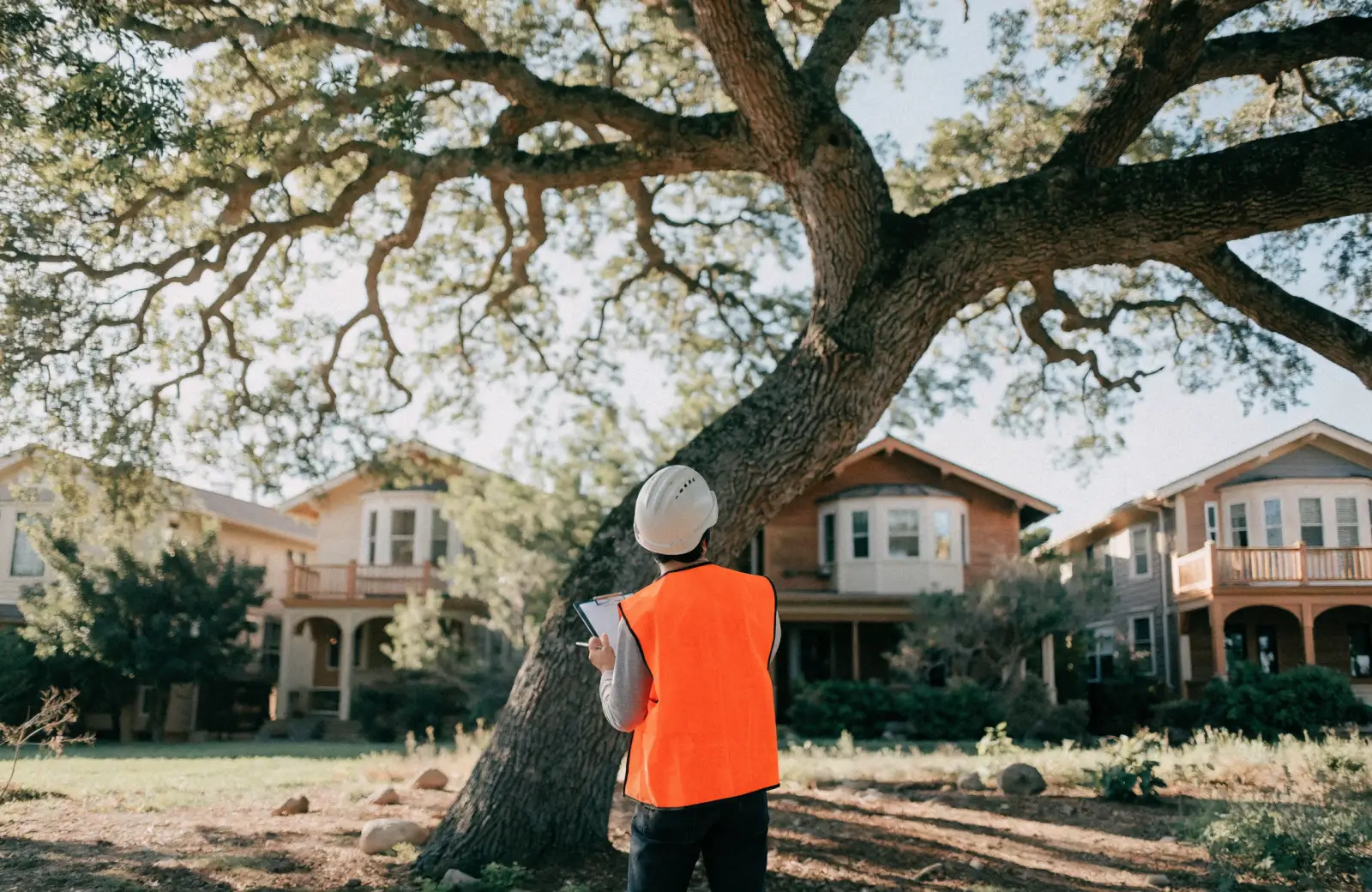
There is a reason to stay calm here beyond the money. A storm-damaged tree is not automatically a dead tree. According to the Arbor Day Foundation, a healthy tree that keeps at least half its canopy can often recover, so a careful assessment usually beats a rushed removal. The honest way to know which bucket your tree is in is a calm diagnosis, and our guide to the signs a tree actually needs removal walks through them one by one. Better yet, a tree health inspection before storm season turns your biggest unknowns into a plan: what to prune, what to watch, and what to take down on your schedule instead of the storm’s.
What to Do in the First 10 Minutes
In the first ten minutes of a real tree emergency, your job is not to fix anything. It is to make the area safe and document what happened, in that order. This is exactly how fire crews think on any scene: control the hazard first, then work the problem. Move through these four steps and you go from panic to a controlled scene fast.
- Clear the fall zone. Get people and pets out of a circle at least as wide as the tree is tall, in every direction.
- Block access. Keep anyone from walking or parking under a loaded tree or a hanging limb. A car across the driveway, cones, or a flashlight on the ground all work.
- Handle any power line first. If a line is involved, call 911 and PG&E at 1-800-743-5000, keep everyone back, and do not touch anything in contact with the tree.
- Photograph before any cutting. Wide shots and close-ups of the tree, the point of failure, and the damage. Two minutes of phone photos is what your insurance claim gets paid on.
Only after the scene is safe should you call an emergency arborist and describe, calmly and specifically, what you are looking at.
How to Tell a Real 24-Hour Service From a Voicemail
A real 24-hour tree service means a live person answers at 2 a.m., you get a phone assessment within minutes, and the first move on your property is making the hazard safe rather than writing an estimate. Much of the industry advertises 24-hour service and delivers a voicemail and an 8 a.m. callback, because nobody is actually on call. In an active emergency, that gap is the whole ballgame.
When you call, listen for a few things. A real emergency crew asks about targets and power lines before it talks about price. It is staffed by ISA-certified arborists and is licensed and insured, which you can and should confirm; the International Society of Arboriculture explains how to check that an arborist is qualified to assess tree risk. And a trustworthy crew will tell you honestly when your situation can wait until morning instead of selling you urgency you do not need.
One more thing worth knowing before you authorize a big overnight job: you often do not need the whole removal done at 2 a.m. In many cases the right call is a make-safe visit tonight to stabilize or remove the immediate hazard, then finish the job in daylight at closer to standard rates. That is the firefighter approach our founders trained under on engine crews, applied to trees: the truck is stocked before the storm hits, someone answers when you call, and hazard control comes first.
Storm-damage cleanup and emergency access clearance are core to what Firefighter Tree Service does, so a tree that failed overnight is familiar ground for the crew. When the situation allows, we secure the hazard the night you call and return in daylight to complete the removal and clean the site, which keeps the work both safer and easier on your budget than forcing the whole job through in the dark.
What Emergency Tree Work Costs
Emergency tree work in the Bay Area often runs more than a scheduled job at many companies, because they bill for a crew and equipment mobilized on no notice, often at night and in bad weather. Firefighter Tree Service does not add an emergency surcharge. The exact number depends on the tree’s size, what it is resting on, and the hour you call. Rather than repeat the full breakdown here, we walked through the premium, what your homeowners policy does and does not cover, and how to avoid overpaying in our guide to emergency tree removal cost.
When Every Minute Counts, Firefighter Tree Service Answers
Tree emergencies do not wait for business hours, and neither do we. Firefighter Tree Service is a firefighter-owned, ISA-certified, insured crew that answers around the clock across Redwood City and the Peninsula, and the first thing we do on any call is make your property safe. If a tree just failed and you are not sure whether it can wait, call and we will tell you honestly, because we would rather talk you out of a callout than bill you for one you did not need. Reach us for emergency tree service in Redwood City at (650) 454-0373, any hour, and you will get a firefighter’s answer: calm, fast, and focused on the hazard in front of you.