The best drought-tolerant shade trees for a Bay Area yard are the ones sized right for your space, matched to your clay soil, and set far enough from the house that their roots never become your problem. Species selection is only half the decision. Where you plant the tree, and how big it gets in 20 years, matters just as much as how little water it drinks.
Most “best shade tree” lists stop at pretty photos and a size range. This one is written the way our crew actually thinks about a planting: canopy shade first, low summer water second, and honest siting cautions so you are not paying to remove the tree in 15 years. Whether you live in Redwood City, San Carlos, Menlo Park, or anywhere on the Peninsula, the right pick can lower your cooling costs, raise your property value, and shrink your water bill at the same time.
What Makes a Tree Both Drought-Tolerant and a Real Shade Tree
A true drought-tolerant shade tree gives you a broad, leafy canopy while needing little to no summer irrigation once its roots are established. That last phrase does the heavy lifting. Almost no tree is drought-tolerant in its first two to three years. The label describes a mature, rooted-in tree, not a nursery sapling you just planted.
This is where a lot of homeowners get burned. They plant an “unthirsty” oak, water it like a cactus from day one, and wonder why it struggles. Drought tolerance is a finish line the tree reaches after you help it build a deep root system first.
It also pays to separate a shade tree from an ornamental. A crape myrtle is a beautiful low-water tree, but at 20 feet it shades a patio, not a house. A valley oak shades a whole backyard. Both belong on this list. Just be clear about which job you are hiring the tree to do before you fall in love with the flowers.
How to Match a Drought-Tolerant Shade Tree to Your Bay Area Yard
Choosing well comes down to four questions, answered in order, before you ever look at a photo. Get these right and almost any species below will thrive. Get them wrong and even the toughest tree becomes a liability.
- How much room do you actually have? Measure the distance from the planting spot to your house, fence, sidewalk, and overhead wires. A tree’s mature spread, not its nursery size, is what has to fit.
- What is your soil? Most Peninsula yards sit on heavy adobe clay that drains slowly. Pick a species that tolerates clay, or plan to amend and mound the planting area.
- How much sun, and how much fog? Inland communities like Redwood City and San Carlos bake in full sun. Coastal pockets near Pacifica or Half Moon Bay stay cool and gray, which changes what will fruit and flower.
- What is the tree’s job? Cooling shade over the roof, a privacy screen along a fence line, or a spring flower show all point to different trees.
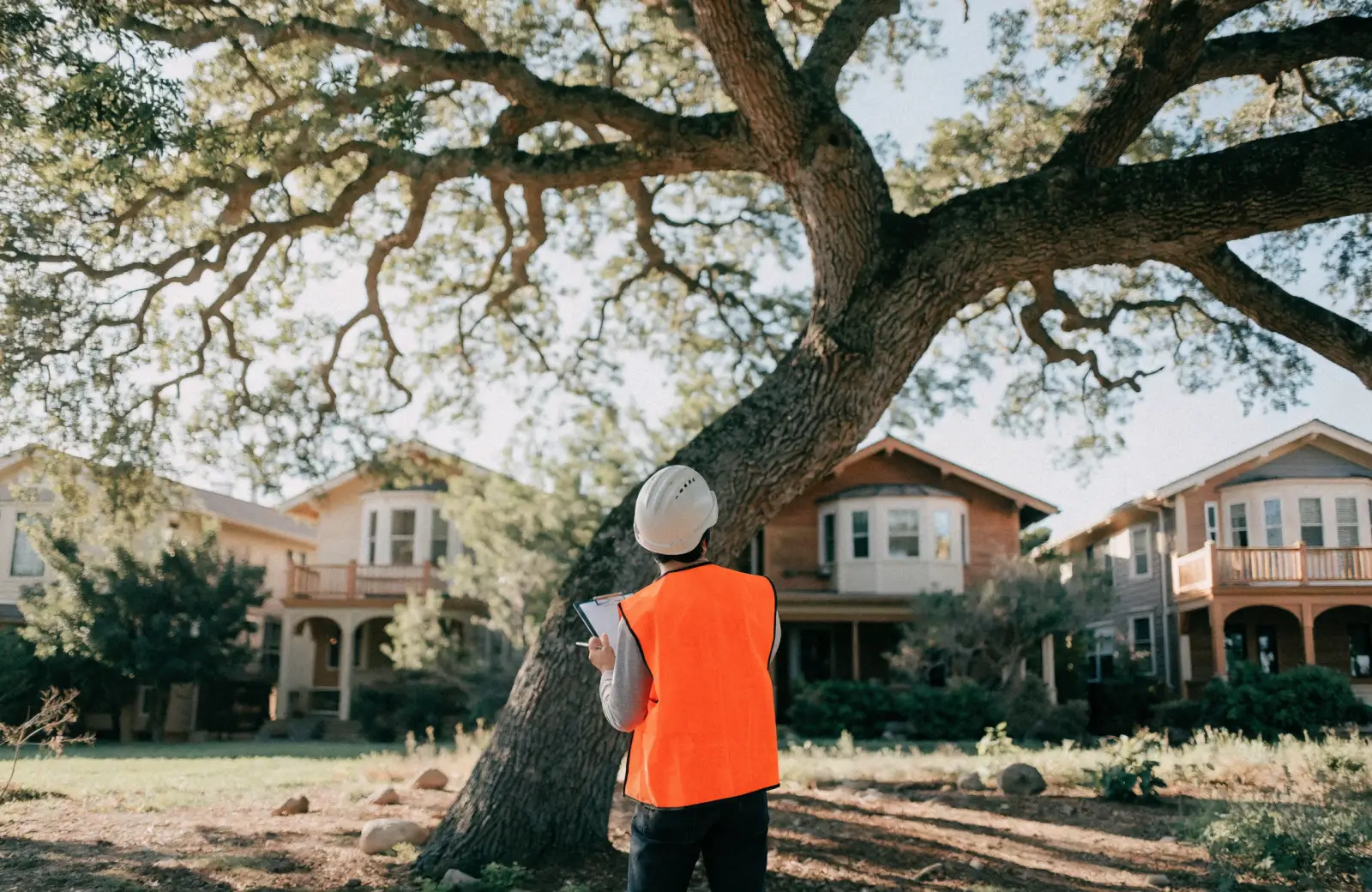
If your real goal is screening rather than overhead shade, start with our guide to fast-growing trees for privacy instead, because the best privacy species are not always the best shade species. And if you want a broader look at what performs locally, our list of the top trees for Redwood City’s climate covers picks beyond drought tolerance alone. When the setback math gets tight, a certified arborist in Redwood City can walk your property and flag problems before they cost you a tree.
7 Drought-Tolerant Shade Trees That Perform in the Bay Area
These seven species all deliver dependable low-water performance once established, and each earns its spot for a different reason. They are ordered roughly from largest canopy to smallest, so read the mature size before you pick.
1. Coast Live Oak (Quercus agrifolia)
The Coast Live Oak is the quintessential Northern California shade tree and the one we recommend most often for a legacy planting. It is evergreen, so it shades year-round, and it is genuinely fire-resistant, a real advantage on the Peninsula’s hillside lots. According to the California Native Plant Society’s Calscape database, it needs no more than one deep watering per month in summer once established.
- Mature size: 25 to 70 feet tall, with a broad 25 to 40 foot canopy that widens on old open-grown trees
- Water needs: Very low once established, adapted to California’s dry summers
- Growth rate: Slow to moderate, about 12 to 24 inches per year
- Best placement: Large yards, set well back from foundations because the canopy and root zone both spread wide
Coast Live Oaks are protected under most Bay Area city ordinances, and mature specimens need a knowledgeable hand; our oak tree care for the Bay Area keeps them healthy for the long haul. Once you plant one, you are investing in a tree that can outlive the house.
2. Valley Oak (Quercus lobata)
The Valley Oak is the largest oak in North America and the biggest canopy on this list. It is deciduous, which is a feature, not a flaw: it drops its leaves in winter and lets sunlight warm your home when you want it, then leafs out for dense summer shade. Calscape lists it reaching roughly 40 feet in 10 years and up to 100 feet at maturity.
- Mature size: 40 to 100 feet tall, 40 to 70 foot spread
- Water needs: Low once established, about twice-monthly summer water at most
- Growth rate: Moderate to fast, faster than most oaks
- Best placement: Large lots and open spaces, ideally a quarter acre or more
A Valley Oak in a small courtyard will create problems within a decade. Give it room or choose something smaller.
3. California Sycamore (Platanus racemosa)
The California Sycamore delivers the fastest big shade of any native here, growing up to 3 feet a year with a massive canopy and striking peeling bark. That speed comes with two cautions: vigorous roots that must stay well clear of sewer laterals and foundations, and a tendency toward anthracnose, a fungus that can drop its leaves after a cold, wet spring before it leafs back out.
- Mature size: 30 to 80 feet tall, 20 to 50 foot spread
- Water needs: Low to moderate once established
- Growth rate: Fast, 24 to 36 inches per year
- Best placement: Large properties and wide parkways only, well away from pipes and pavement
4. Chinese Pistache (Pistacia chinensis)
If you want a right-sized shade tree with jaw-dropping fall color and roots that stay out of trouble, the Chinese Pistache is the safest pick on this list. The UC Statewide Integrated Pest Management Program notes it tolerates both lawn irrigation and very little water in deep soils, and it is resistant to oak root fungus. Its root damage potential is rated low, which makes it one of the few larger shade trees you can plant near a patio or sidewalk with confidence.
- Mature size: 30 to 40 feet tall, 25 to 35 foot spread
- Water needs: Low once established
- Growth rate: Moderate, about 24 inches per year
- Best placement: Front yards, street plantings, and patios. Choose male trees to avoid berry litter.
5. Brisbane Box (Lophostemon confertus)
The Brisbane Box is the workhorse evergreen street tree you already see lining downtown Redwood City, Palo Alto, and San Mateo. It is clean, fast, and shrugs off compacted urban soil and reflected heat, which makes it a reliable choice where fancier trees fail.
- Mature size: 30 to 45 feet tall, 20 to 30 foot spread
- Water needs: Low once established
- Growth rate: Fast, 24 to 36 inches per year
- Best placement: Street plantings, driveways, side yards, and evergreen screens
6. Crape Myrtle (Lagerstroemia indica)
The Crape Myrtle is the patio-scale option, trading a big canopy for a two to three month summer flower show in white, pink, red, or purple. Think of it as shade for a seating area rather than a house. It loves heat and full sun, so it thrives in Redwood City and San Carlos but sulks in fog.
- Mature size: 15 to 30 feet tall, 15 to 25 foot spread
- Water needs: Low to moderate once established
- Growth rate: Fast, 24 to 36 inches per year
- Best placement: Front yards, patios, and sunny courtyards; smaller varieties do well in large containers
7. Western Redbud (Cercis occidentalis)
The Western Redbud is the native understory tree on this list, and it is honest work to call it more than a small accent. It will not shade your roof, but at 15 to 25 feet it fills a tight corner and covers its bare branches in magenta-pink blossoms every March before the leaves emerge. It is one of the most drought-hardy trees you can plant.
- Mature size: 15 to 25 feet tall, 15 to 20 foot spread
- Water needs: Very low once established
- Growth rate: Moderate, 12 to 18 inches per year
- Best placement: Small yards, garden borders, and understory beneath larger oaks
Drought-Tolerant Shade Tree Comparison
| Tree | Mature Height | Spread | Water Needs | Growth Rate | Evergreen? | Native? |
|---|---|---|---|---|---|---|
| Coast Live Oak | 25 to 70 ft | 25 to 40 ft | Very Low | Slow to Moderate | Yes | Yes |
| Valley Oak | 40 to 100 ft | 40 to 70 ft | Low | Moderate to Fast | No | Yes |
| California Sycamore | 30 to 80 ft | 20 to 50 ft | Low to Moderate | Fast | No | Yes |
| Chinese Pistache | 30 to 40 ft | 25 to 35 ft | Low | Moderate | No | No |
| Brisbane Box | 30 to 45 ft | 20 to 30 ft | Low | Fast | Yes | No |
| Crape Myrtle | 15 to 30 ft | 15 to 25 ft | Low to Moderate | Fast | No | No |
| Western Redbud | 15 to 25 ft | 15 to 20 ft | Very Low | Moderate | No | Yes |
Two more names worth knowing: London plane and ginkgo. London plane handles clay and city stress well but shares the sycamore’s aggressive roots and anthracnose habit, so site it with the same caution. Ginkgo is nearly indestructible and clean once established, though it grows slowly enough that you plant it for the next owner as much as yourself.
Bay Area Clay Soil and Roots: Where to Plant So You Don’t Regret It
The most expensive mistake homeowners make is planting the right tree in the wrong spot, and in the Bay Area that almost always traces back to clay soil and roots. Our adobe clay holds water and drains slowly, so trees that tolerate it (oaks, Chinese pistache, sycamore) thrive, while species that demand fast drainage rot at the root.
Roots are the part people worry about most, and the worry is mostly misplaced. Roots rarely “attack” a foundation or pipe out of nowhere. They follow existing moisture, and they exploit cracks that are already there, which is exactly what we explain in our breakdown of tree roots and foundation or sewer damage. The practical fix is distance. Give a large tree like a Valley Oak or California Sycamore at least 15 to 20 feet of clearance from the house and any sewer lateral, and lean on lower-risk species like Chinese Pistache when the space is tight.
Here is the arborist’s rule we hold to: match the mature size to the spot before anything else. A tree that has to be topped, root-pruned, or removed because it outgrew its space was the wrong tree, no matter how drought-tolerant it was.
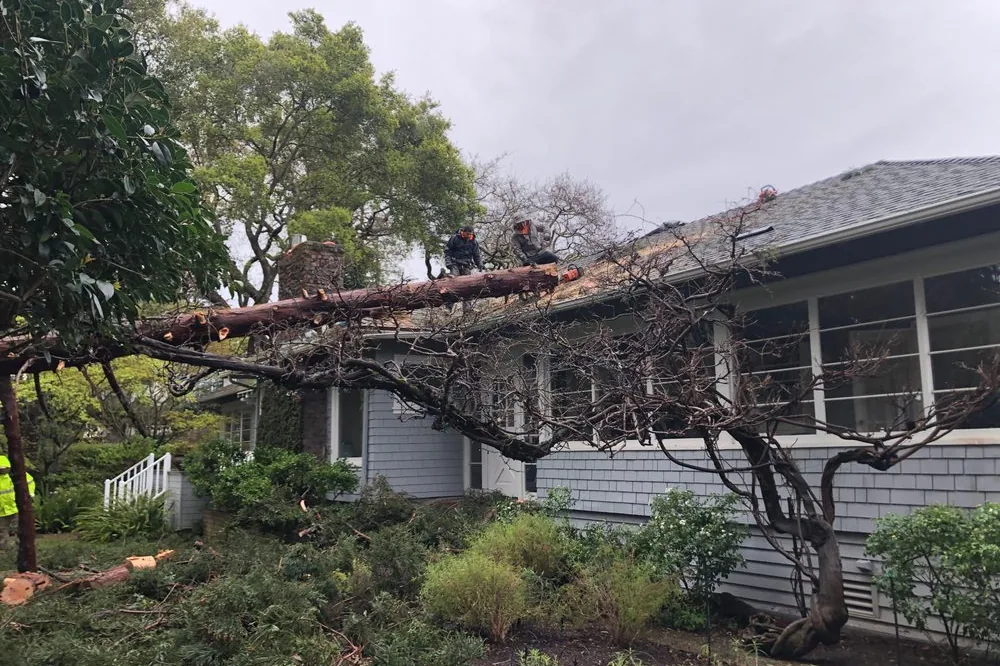
We see this constantly: a beautiful shade tree planted too close to the house, where its roots and spreading canopy were always going to become a problem. The right tree in the wrong spot creates years of avoidable pruning and root conflicts, and sometimes a removal that never should have been necessary. No amount of drought tolerance makes up for the wrong planting distance.
Fire-Resistant Shade for Hillside Lots
For homes in the wildland-urban interface, a drought-tolerant shade tree should also be a fire-smart one, and the two goals line up more often than not. Evergreen natives like the Coast Live Oak hold moisture in their leaves and resist ignition better than resinous conifers or dry, weedy species. On lots in Woodside, Portola Valley, and the Los Altos Hills, that resistance is worth as much as the shade.
Placement still governs the outcome. Cal Fire’s defensible space guidance calls for spacing tree canopies apart and keeping them clear of the house so fire cannot ladder from the ground into the crown. When shade planting and clearance work against each other, clearance wins. Our overview of defensible space and tree clearing in California walks through how to keep the shade you want without building a fire path to your roof.
Planting and Establishing a Drought-Tolerant Tree
Even the toughest species needs deliberate care for its first two to three years, and the establishment period decides whether the tree thrives or limps along. The single most common killer is planting too deep. Set the tree so the trunk flare stays visible, in a hole two to three times wider than the root ball but no deeper, as the International Society of Arboriculture advises.
Follow these four steps to give a new tree the best start:
- Water deeply but infrequently. Deep, spaced watering pulls roots downward toward stable moisture instead of keeping them shallow and thirsty.
- Mulch generously. Spread 3 to 4 inches of wood chips over the root zone, kept a few inches off the trunk.
- Plant in fall. A fall planting hands the tree the entire rainy season to root in before its first dry summer.
- Prune early and lightly. Light structural pruning in the first few years builds a strong framework and heads off costly problems later.
Do this, and by year three you will have a tree that mostly takes care of itself: lower water bills, cooler summers, and shade that keeps growing for decades.
Plant the Right Tree with Firefighter Tree Service
Choosing the species is the easy part. Planting depth, soil prep in heavy clay, correct setbacks, and early structural pruning are what separate a tree that thrives from one you replace in ten years. At Firefighter Tree Service, our ISA-certified, firefighter-owned crew helps Redwood City and Peninsula homeowners select, site, and establish drought-tolerant shade trees that perform for the long haul. When you are ready to get it right the first time, reach out for our tree planting and transplanting services or call us at (650) 454-0373 for a free consultation.