
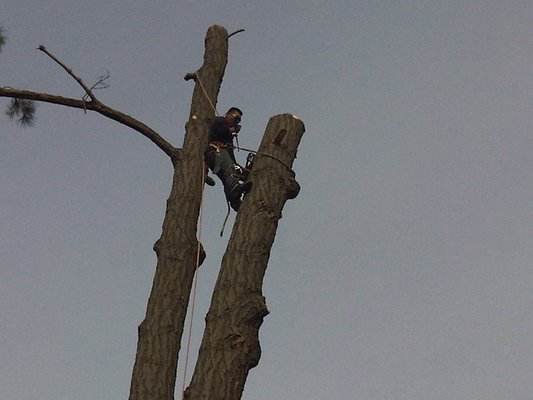
24-Hour Emergency Tree Removal: What It Costs & What to Expect
A tree on your house, car, or driveway cannot wait until Monday. Our firefighter-trained crew answers around the clock, makes your property safe first, and gives you a clear price before a single cut.
Free Estimate
Request a Service
Describe your project and we'll get back to you within 24 hours.
Is This an Emergency? Call Now or Wait for Morning Rates
A tree situation is an emergency when a tree or large limb is on a structure, a vehicle, or a power line, is blocking your only way in or out, or is visibly failing with something valuable underneath it. Everything else, including most trees that have leaned the same way for years, can usually wait for a scheduled visit at standard rates. Knowing the difference is the single biggest lever on your bill.
Call us right now if any of these is true:
- A tree or large limb is on your house, garage, or car
- A cracked or hanging branch is suspended over a roof, driveway, or play area
- A tree is touching or leaning into a power line (call 911 and PG&E first, then us)
- A tree is partially uprooted and leaning toward a structure, or the soil is lifting on one side
- A fallen tree is blocking your only access to the property
If you are standing in your yard at 2 a.m. with a flashlight, wondering whether the cracking sound you just heard means you should call someone, that uncertainty is normal. Call anyway. A phone assessment costs nothing, and we would rather talk you out of an emergency callout than bill you for one you did not need. If your situation is a dead tree in an empty corner of the lot or a lean that has looked the same since you bought the house, we will say so, and you can book a scheduled visit at standard rates instead. Our guide on when to call an emergency arborist walks through the gray areas in detail.
What Happens When You Call (650) 454-0373
When you call, you reach a person, not a voicemail. You get a phone assessment within minutes and, for a genuine hazard, a crew or a firm arrival window. Typical response for Redwood City addresses is under 90 minutes. During major storms we triage by risk: trees on structures and near power lines come first. Here is the whole process, step by step:
- Phone size-up. Tell us what fell, what it is touching, and what it is threatening. If it is safe to take photos, they help us load the right equipment.
- Triage and arrival window. We tell you honestly whether your situation needs a crew tonight or can wait for daylight rates, and when we will be there.
- Scene assessment on arrival. The same size-up we learned on fire scenes: what can fail, what it hits when it fails, and where the crew goes if something moves. We do not start chainsaws until that is answered.
- A clear price before cutting. Whether the job is a make-safe visit or a full removal, you get the number before work begins, not after.
- Stabilize, remove, document, clean up. We photograph the scene before and after, remove or secure the hazard, and leave you an itemized invoice your insurance adjuster can actually process.
"We had two redwood trees come crashing onto our house during the March 2023 'bomb cyclone' event, punching a hole through our roof... Dennis came out within 2 hours, and Miguel and his 7-man team were on site the very next morning. They skillfully removed the redwoods, piece-by-piece, without damaging the house further."
Pete F., Yelp review of Firefighter Tree Service
What Emergency Tree Removal Costs
We do not charge extra for emergency tree removal. A tree we remove at 2 a.m. is priced the same as that tree on a scheduled weekday, and our removals start at about $1,000 per tree. That is not the norm. Across the Bay Area, emergency removals typically cost $1,000 to $5,000 per tree, roughly 1.5 to 3 times the scheduled rate, because many companies bill a premium for mobilizing a crew in the dark and in bad weather. The table below shows typical market prices so you can compare the quotes you get.
| Emergency scenario | Typical Bay Area cost |
|---|---|
| Large limb down, blocking a driveway or yard, daytime | $600 to $1,200 |
| Whole tree down in the yard, no structure contact | $1,000 to $2,500 |
| Tree on a roof, fence, or vehicle, standard access | $2,500 to $5,000 |
| Large tree on a structure, crane required, after hours | $4,000 to $8,000+ |
Say you are staring at an $8,000 quote for a big oak lying across your roof and wondering if you are being gouged. Probably not. A tree resting on a house is under load, every cut changes where thousands of pounds go next, and that job is hours of roped, piece-by-piece dismantling. Homeowners around the country report $6,000 to $9,000 for exactly that work. What should make you suspicious is a big number with no line items, not the big number itself.
For the full breakdown of where the money goes, including the after-hours callout minimum and crane mobilization fees, see our emergency tree removal cost guide. Want a number for your exact tree? Our interactive tree removal cost calculator includes an emergency option.
What Moves the Price Up or Down
Four inputs drive every emergency quote: tree size, what the tree is resting on, access, and timing. A limb in open grass at 2 p.m. sits at the bottom of the range. A crane job over a sunroom at 2 a.m. sits at the top.
- Size and species. A 90-foot eucalyptus is a different project than a 25-foot plum.
- What it hit. A tree under load on a roof requires slow, rigged dismantling. Open-ground removal is faster and cheaper.
- Access. Tight backyards, slopes, and soft, saturated soil add crew time or machinery.
- Time of night. After-hours crew mobilization typically adds $500 to $1,500 before the first cut.
- Cranes. Emergency crane mobilization can add $1,500 to $3,000 versus a scheduled booking.
- Power lines. Utility coordination adds time, and no work starts until the line is cleared.
You May Not Need the Whole Job Done Tonight
In many emergencies the right move is a make-safe visit tonight and the full removal in daylight, at closer to standard rates. Stabilizing or removing the immediate hazard costs a fraction of a full after-hours removal, and it is exactly how fire crews are trained to work: control the hazard first, then work the scene methodically. We are a firefighter-trained company, and this is the most common money-saving advice we give at 2 a.m.
Picture an oak limb through your garage roof at 11 p.m. The overnight job is cutting the limb free, tarping the hole, and confirming nothing else is coming down. The removal, chipping, and haul-off happen the next morning in daylight, at daytime rates. Any service that insists the entire tree must come down tonight, at tonight's prices, when the hazard could be secured for far less, is selling you urgency you may not need. We will tell you on the phone which situation you have.
Will Homeowners Insurance Cover It?
Homeowners insurance generally covers emergency tree removal when the tree fell because of a covered peril, like wind, and hit an insured structure: your house, garage, or fence. If the tree fell in the yard and hit nothing, most policies pay nothing toward removal, no matter how dramatic the failure looked. And even when removal is covered, policies typically cap that line item at about $500 to $1,000 per tree, according to the Insurance Information Institute, which is far below most emergency bills. Plan for the gap.
Your situation determines your next move:
- Storm-felled tree hit your house, garage, or fence: this is a claim. Follow the four steps below and do not wait for an adjuster before making the property safe, since most policies require you to prevent further damage.
- Tree fell in the yard and hit nothing: removal is usually out of pocket. Skip the claim and avoid the premium impact. Our price is the same whether you call tonight or schedule it.
- The tree was visibly dead or rotten and you knew it: be careful. Insurers can deny claims for neglected maintenance. If an inspection has flagged a hazardous tree, removing it on your schedule is far cheaper than pulling it off your roof later.
Filing the claim without slowing down the removal:
- Photograph everything before any cutting starts. Wide shots and close-ups of the tree, the point of failure, and the damage.
- Authorize emergency make-safe work immediately. Stopping further damage is your responsibility under most policies.
- Ask for an itemized invoice. Emergency response, removal, and debris hauling as separate line items. We do this by default.
- Call your insurer within 24 hours and send the photos and invoice together.
Say your neighbor's eucalyptus drops a limb through your fence during a January storm. It is your own policy that pays for your fence and the removal, not theirs, unless you can prove they ignored written warnings about a visibly failing tree. That feels backwards, but it is how claims actually work, and it is why documenting a worrying neighbor tree in writing before it fails matters so much. We broke down the California rules in plain English in our guide to neighbor trees and overhanging branches under California law.
A Tree on a Power Line Follows Different Rules
If a tree or branch is touching a power line, nobody works that tree until the utility de-energizes or clears the line, our crew included. Treat every downed line as live: keep people and pets far away, call 911, then PG&E at 1-800-743-5000. PG&E's electric safety guidance is blunt about this: always assume a downed line is energized, and never touch anything in contact with it, including the tree. Any tree company willing to cut an energized tree is one you should hang up on. Once the line is cleared, we handle the rest.
Emergency Coverage Across the Peninsula and South Bay
We dispatch emergency crews from Redwood City around the clock and cover the Peninsula and South Bay. In Redwood City itself, that includes Emerald Hills, Farm Hill, Roosevelt, the Woodside Road corridor, and the Stambaugh-Heller area. As the tree service Redwood City homeowners have trusted for over 500 properties, we know these streets, these species, and these storm patterns.
- Emergency tree removal in Redwood City
- Emergency tree service in San Carlos
- Emergency tree service in Menlo Park & Atherton
- Emergency tree service in Burlingame
- Emergency tree removal in Palo Alto
- Emergency tree service in Mountain View
We also respond to emergencies in Woodside, San Mateo, and San Francisco. If you are unsure whether you are in our coverage area, call. If we cannot get to you fast enough, we will say so on the phone.
One more thing worth doing once the emergency is over: the trees that end up on roofs are almost never the ones being watched. A tree health inspection before storm season costs a small fraction of one emergency callout and converts your biggest unknowns into a plan, so the next storm is something you watch from the window instead of the driveway.
Frequently Asked Questions
For Redwood City addresses, our typical emergency response time is under 90 minutes. During major storm events when call volume spikes, we triage by safety risk: trees on structures or near power lines come first. Either way, you get a live phone assessment and a firm arrival window when you call, not a voicemail.
Yes. When you call (650) 454-0373 you reach a person who can dispatch a crew, at any hour. Much of the industry advertises 24-hour service but routes after-hours calls to voicemail and a next-morning queue. Our crews are built around firefighter readiness culture: someone answers, and the truck is stocked before the storm hits.
With us, an emergency removal costs the same as a scheduled one. We do not charge an emergency or after-hours surcharge. Across the Bay Area, many companies bill 1.5 to 3 times their scheduled rate for urgent work, so emergency bills of $1,000 to $5,000 per tree are common. Our price depends on tree size, what the tree is resting on, access, and whether a crane is needed, and you get a clear estimate before any work begins.
Usually yes, if the tree fell because of a covered peril like wind and hit an insured structure such as your house, garage, or fence. If the tree fell in the yard and hit nothing, most policies pay nothing toward removal. Even when covered, policies typically cap the removal line item around $500 to $1,000 per tree, so expect a gap. We provide the photos and itemized invoice your claim needs.
In almost every case, your own homeowners policy handles the damage and the removal, not your neighbor's. If the tree was healthy and the storm brought it down, that is treated as an act of nature and no one is at fault. The exception is documented negligence: if your neighbor ignored written warnings about a visibly dead or failing tree, your insurer may pursue their policy and refund your deductible.
Yes, when it is safe to operate. Some situations require us to wait for wind speeds to drop before using aerial equipment, but we will be on site to assess the hazard and secure the area either way. If a power line is involved, nobody touches the tree until PG&E clears it.
Yes, and it is often the smartest call. A make-safe visit stabilizes or removes the immediate hazard tonight, then the full removal and cleanup happen in daylight at closer to standard rates. We will tell you on the phone whether your situation needs the whole job now or just hazard control.
Call Firefighter Tree Service at Any Hour
Emergency tree work is where our firefighter roots show the most: a live answer at 2 a.m., hazard control first, and straight talk about what has to happen tonight versus what can wait for daylight rates. Our ISA-certified, insured crews respond across Redwood City, the Peninsula, and the South Bay. Call (650) 454-0373 now, or if your tree can wait until morning, request a free estimate and we will schedule it at standard rates.
Testimonials
What Our Clients Say
Get Started Today
Ready to Get Started?
Whether it's an emergency removal or routine tree care, Firefighter Tree Service is ready. Call us now or request a free consultation from our certified arborists.
Firefighter-owned · ISA Certified Arborists · Insured