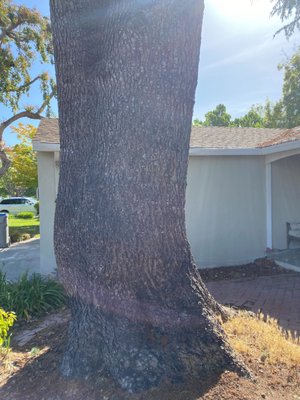
Good tree pruning comes down to removing the right branches, in the right places, with cuts a tree can seal on its own. Done well, pruning makes a tree safer, healthier, and stronger for decades. Done wrong, it invites decay, weak regrowth, and an early death you will not notice until it is too late. Most trees that get “trimmed” in the Bay Area are cut to a habit or a price sheet, not to how a tree actually heals, and the tree pays for it slowly.
If you just moved into a home with mature oaks or redwoods you did not plant, or you are holding a bid from a crew that wants to “shape” or “round over” your tree, this guide is written for you. It covers the how: the cuts, the pruning types, and the standards that separate real arboriculture from butchery. For the when, meaning which months suit which species, see our companion guide on the best time to prune trees.
What Tree Pruning Actually Does for a Tree
Tree pruning is the selective removal of specific branches to improve a tree’s structure, health, and safety. It is not haircut-style shaping, and a healthy tree does not need to be cut every year. You prune with a reason: to take out dead or diseased wood, to correct weak structure while a tree is young, to lift the canopy for clearance, or to lower risk near a house, driveway, or power line.
A useful filter arborists teach is the four D’s: remove wood that is Dead, Diseased, Damaged, or Dangerous, and think hard before you remove anything else. Every leaf you cut off is food the tree can no longer make, so live, healthy branches earn their place until there is a clear reason they should go. When pruning is done for the right reasons and on the right schedule, the payoff is real: better structure, fewer failures in storms, and longer life. Those returns are worth understanding before you spend a dollar, and we break them down in our guide to the benefits of professional tree trimming.
The Anatomy of a Proper Pruning Cut
A proper pruning cut is made just outside the branch collar, the slightly swollen ring of tissue where a branch joins the trunk, and it never slices into that collar or leaves a stub. The collar holds the cells that grow over a wound and wall off decay. Cut through it with a flush cut and the tree cannot seal, so rot moves straight into the trunk. Leave a long stub instead and the dead wood decays back toward the trunk before the tree can close it.
Here is the sequence a good cut follows:
- Find the branch collar and the branch bark ridge, the raised line of bark in the fork where branch meets trunk. Your cut goes just outside both, angled slightly away from the trunk.
- On any limb heavier than your wrist, use the three-cut method so the falling branch cannot tear the bark. Make an undercut a foot or so out from the trunk, then a top cut a little farther out to drop the limb, then a final clean cut at the collar.
- Check the finished wound. It should look nearly round, not oval, and the collar should still be there.
One of the most common things people ask after a weekend of yard work is whether they already hurt the tree. If your cuts left flat stubs or removed the swollen base of the branch, that is a flush cut, and it is worth having an arborist look before decay sets in. Bark that peeled down the trunk when a heavy limb dropped is the other warning sign, and it is exactly what the three-cut method prevents.
The Four Pruning Types a Certified Arborist Uses
Professional pruning comes down to four methods, and a certified arborist should tell you which one your tree needs and why before making a single cut. These four are defined by the International Society of Arboriculture and the ANSI A300 standard, and each removes different branches for a different purpose. According to the ISA’s guidance on pruning mature trees, they are the foundation of every legitimate pruning plan.
| Pruning Type | What It Removes | Why You Would Use It |
|---|---|---|
| Crown cleaning | Dead, dying, diseased, and weakly attached branches | The safest, most universal starting point for any tree |
| Crown raising | Lower limbs, to lift the bottom of the canopy | Clearance over sidewalks, driveways, roofs, and sight lines |
| Crown thinning | A modest share of live branches throughout the canopy | Lets light and wind pass through without changing the tree’s shape |
| Crown reduction | Height or spread, cut back to living lateral branches | Shrinks a tree the correct way, keeping its natural form |
Crown thinning is the one homeowners most often get wrong. Done right, it removes a small, even share of branches so the canopy breathes. Done wrong, it turns into “lion-tailing,” where a crew strips the interior and leaves tufts at the branch tips, which actually makes limbs weaker in wind. Crown reduction matters even more, because it is the honest way to make a big tree smaller. A real reduction cut shortens a branch back to a living side branch at least a third the diameter of what you removed, so that lateral takes over as the new leader. That distinction is the whole difference between good pruning and the practice we cover next.
Why Topping Is the One Method to Refuse
Topping is the most harmful pruning practice there is, and you should refuse it every time it is offered. Topping means cutting a tree back to stubs or lopping off the top to force it shorter, and it strips 50 to 100% of the leaves the tree lives on. In response, the tree throws out a burst of fast, weak shoots from below the cuts, and those shoots are poorly attached and prone to breaking. The large stub wounds are too big to seal, so decay moves into the trunk. As Purdue Extension explains, the roots die back too, and a topped tree can be shortened in lifespan or killed outright within a few years.
The problem is that topping is often sold as “reduction,” and most people cannot tell the two apart in a bid. Here is the tell: a reduction cut always goes back to a living lateral branch that becomes the new growing tip, so the tree keeps a natural outline. Topping cuts to a bare stub with nothing left to take over, which is why the regrowth comes in as a thicket of weak sprouts. If a crew proposes to “cut it down by a third,” ask exactly where each cut lands. If the answer is “we round it over” or “we take the top off,” that is topping, and a healthy tree does not need it.
In practice, this is a request we turn down. When a homeowner asks us to top a tree to bring its height down, we walk them through a proper crown reduction instead, cutting back to living laterals so the tree keeps its natural form and never grows the weak, hazardous regrowth that topping forces. Running an arborist service means the honest answer sometimes costs us the easy version of the job, and we would rather protect the tree than take a shortcut that shortens its life.
The 25% Rule: How Much Is Safe to Remove at Once
Never remove more than about 25% of a tree’s live canopy in a single year, and take far less from a mature tree. Every leaf is doing work, so stripping too many at once starves the tree and triggers stressed, unhealthy growth. The City of Portland’s urban forestry standards put the ceiling at 20 to 25% of the canopy per pruning cycle, and that is a sensible cap for the Bay Area too.
On an older tree, real pruning often means removing far less than that. Taking 5 to 10% of the canopy, mostly dead and crossing wood, is frequently all a mature oak or redwood should lose in one visit. This is the point most homeowners find surprising: more cutting is not better cutting. A tree that looks barely touched after a pruning job is usually the one that was pruned correctly. If a bid promises to remove half the canopy to “open it up,” that is a warning, not a feature.
What ANSI A300 and ISA Standards Mean for Your Tree
ANSI A300 is the national standard for how tree work should be performed, and the ISA Best Management Practices turn that standard into field technique. When a company says it works to A300 and staffs ISA-certified arborists, it means your tree gets cut to a written professional standard instead of to whatever a crew feels like that day. This is the single best signal you have that the four pruning types, the branch collar cut, and the 25% ceiling will actually be followed.
You do not need to be an arborist to vet one. Before you hire, ask for these four things:
- Proof that the person planning the work is an ISA-certified arborist, not just an equipment operator.
- A current certificate of insurance, including liability and workers’ compensation.
- A written scope that names the pruning type for each tree and references ANSI A300.
- A plain-language reason for every major cut. A qualified pro can explain the branch collar and the 25% rule on the spot.
If a bidder cannot explain why a cut is being made, or waves off the branch collar and the dose limit as details that do not matter, keep looking. The same goes for doing it yourself. Small, low, dead branches are reasonable to remove with clean hand tools. Anything overhead, near wires, or thicker than your wrist is a job for a crew with the training, gear, and insurance to do it without getting hurt or damaging the tree. When you want the work checked or done to standard, a certified arborist in Redwood City is the right call.
Pruning Young Trees vs Mature Trees
Young trees and mature trees call for opposite mindsets: prune young trees lightly and often to build good structure, and prune mature trees rarely and conservatively to preserve it. The best time to shape a tree is in its first 10 to 15 years, when small cuts guide a strong single leader and well-spaced branches. Structural pruning at that stage prevents the co-dominant stems and weak forks that fail decades later, and it costs a fraction of what corrective work on a big tree runs.
Mature trees are a different job. By then the structure is set, so pruning is mostly cleaning out dead and hazardous wood and making careful clearance cuts, never a heavy reshaping. Redwoods are a good local example, because they respond poorly to aggressive cutting and rarely need much beyond deadwood removal and clearance. We walk through that species in detail in our guide on how to prune a redwood tree. For most established trees, a light, scheduled tree trimming pass every three to five years does more good than one big intervention ever will.
Pruning for Fire Clearance in the Bay Area
In Bay Area fire country, pruning does double duty: it keeps trees healthy and it builds defensible space around your home. That means raising the lower canopy so a ground fire cannot climb into the tree, a path firefighters call a ladder fuel, and keeping limbs back from the roof, chimney, and power lines. On a hillside property in Woodside, Los Altos Hills, or the wooded edges of the Peninsula, this clearance work is as much about protecting the house as protecting the tree.
Fire-smart pruning still follows every rule above. You do not top a tree to make it fire-safe, and you do not blow past the 25% limit to open up clearance in one season. You raise and clean the canopy in stages, using proper cuts, so the tree stays healthy while the ground beneath it stays clear. Storms and dead limbs do not wait for business hours either, which is why a crew with 24-hour emergency response and a firefighter’s habit of planning for the worst case is worth having on call before you need it.
Defensible-space and clearance work is core to what this firefighter-owned crew does, so staged, standards-based fire pruning is a regular part of our week across the Peninsula. On the hillside and wooded lots where it matters most, we raise and clean the canopy in stages using proper cuts, keeping the tree healthy while the ground beneath it stays clear.
Frequently Asked Questions
How often should a tree be pruned? Young trees benefit from a light structural pass every two to three years, while established trees usually need attention only every three to five years. Dead, diseased, or clearly hazardous branches can and should be removed any time you spot them.
Can pruning actually make my tree smaller? Yes, through crown reduction, but only within limits. A proper reduction shortens branches back to living laterals and stays under the 25% ceiling, so the tree keeps its natural shape. Topping is not a smaller tree, it is a damaged one.
How much does tree pruning cost in the Bay Area? Pricing depends on tree size, access, and how much work the canopy needs, so a single average is misleading. For real local ranges and what drives them, see our breakdown of tree trimming cost in the Bay Area.
Do I need a permit to prune my trees? Most routine pruning on private property needs no permit, but protected heritage trees and any work affecting the public right of way can require authorization in Redwood City and nearby towns. Check with your city before major work on a large or protected tree.
Tree Pruning in Redwood City with Firefighter Tree Service
Firefighter Tree Service is a firefighter-owned crew of ISA-certified arborists who prune to the standards in this guide, not against them. We have cared for more than 500 residential properties across the Peninsula and South Bay, we are insured, and we back our work with a 3-day service guarantee. If you want your trees pruned by people who can explain every cut, schedule tree pruning in Redwood City or call us at 650-454-0373 to walk your property together.