Most coast redwoods need very little pruning, and the most common mistake homeowners make is cutting too much. A healthy coast redwood (Sequoia sempervirens) is built to grow tall and straight on its own, so good pruning is mostly about removing what is dead or in the way, not reshaping the tree. If you just bought a home in Redwood City and inherited a towering redwood in the yard, the safest first move is to do less than you think.
Redwood City is named for these trees, and coast redwoods are among the trees that thrive in Redwood City’s climate. This guide covers what to prune, what to leave alone, and the cuts that quietly kill a redwood over a few years.
Should You Prune a Coast Redwood at All?
Most of the time, barely. A coast redwood in good health does not need shaping, thinning, or height control to stay healthy. Pruning is worth doing to remove dead, broken, or diseased branches, to lift the lowest limbs for clearance, and to keep the tree safe around your house. Beyond that, less is more.
These trees can reach 300 feet or more and live over 2,000 years, and they do it with almost no help from us. According to Redwood National and State Parks, coast redwoods regularly grow past 350 feet and can live for two millennia. A tree with that kind of built-in vigor does not need a yearly haircut. If your redwood looks a little wild, that is usually the tree being a redwood, not a problem to fix.
The pressure to “clean it up” often comes from a neighbor, an HOA, or a fear of the tree in a storm. Those are real concerns, and there are right ways to handle them below. But reaching for the saw first is how a strong tree gets weaker.
Coast Redwood or Dawn Redwood? Know Which Tree You Have
Before you cut anything, confirm which redwood you own, because the pruning rules differ. The two you will find in Bay Area yards are the coast redwood (Sequoia sempervirens), an evergreen with soft flat needles that stays green all year, and the dawn redwood (Metasequoia glyptostroboides), a deciduous conifer that turns copper and drops its needles every fall. A third, the giant sequoia, is bulkier and native to the Sierra, and it is far less common in coastal yards.
This matters more than it sounds. A lot of “how to prune a redwood” advice online is actually written about dawn redwoods, which handle shaping cuts differently than coast redwoods do. If your tree loses its needles in winter, it is a dawn redwood, and it can take a bit more structural pruning while young. If it stays green through a Redwood City winter, it is a coast redwood, and the cautious approach in this guide is the one to follow.
When to Prune a Coast Redwood
The best time to prune a coast redwood is late winter to early spring, while the tree is in its short dormant period, roughly January and February in our area. Cuts made then heal fastest, because the tree seals the wound with the flush of spring growth that follows. You can safely remove a dead or hazardous branch at any time of year, since dead wood is not part of the living tree.
Avoid heavy pruning in late fall, when the tree is winding down and wounds sit open through the wet season, and skip hot, dry summer spells that already stress the tree. For a fuller breakdown of timing across different species, see our guide on the best time to prune trees.
What to Prune, and What to Leave Alone
On a coast redwood, prune three things and leave the rest: dead or diseased wood, broken or crossing branches, and low limbs that block a walkway, roof, or driveway. Everything else, including the tree’s natural shape and its interior foliage, should usually stay. Arborists call the safe version of this work crown cleaning, and it is the single most useful thing you can do for a redwood.
Here is the short list of what is fair game:
- Dead, damaged, or diseased branches. Look for bare, brittle limbs, peeling bark, or browning foliage. Removing them protects the rest of the tree and the people under it. If you are not sure whether a limb is dead or just stressed, a tree health inspection can settle it.
- Broken and crossing branches. Limbs that rub each other create wounds that invite decay. Take out the weaker of the two.
- Basal sprouts and low clearance limbs. Redwoods send up sprouts from the base and burl, which is the tree cloning itself for insurance. These are fine to remove for a tidy look, and you can lift the lowest branches where you need clearance.
What to leave alone: the central leader, the healthy interior branches, and the overall silhouette. A redwood pruned back to its natural form looks best when you can barely tell it was pruned at all. On wind-prone or wooded lots, leaving some live lower branches actually gives the trunk protection and helps the tree absorb a limb that falls from above.
What You Cut Won’t Grow Back
Coast redwoods do not reliably regrow foliage from bare, older wood, so a cut branch usually stays gone. Unlike many broadleaf trees that push fresh shoots from a stub, a redwood limb cut back into leafless wood often will not fill back in. That is why over-cutting leaves permanent holes in the canopy, and why arborists keep repeating the same warning: what you trim off, stays off.
This is not just folklore. A U.S. Forest Service study on coast redwood pruning found that trees keeping 40 to 60 percent of their live crown showed minimal stress sprouting and no lasting effect on growth, while the most severe cuts, which left only about 15 percent of the crown, triggered heavy sprouting. In plain terms, a redwood tolerates a modest, thoughtful prune and punishes a heavy one. Plan every cut like you cannot take it back, because on a redwood, you often cannot.
The Right Way to Make a Cut
Cut just outside the branch collar, the slightly swollen ring where the branch meets the trunk, and never leave a stub or cut flush against the bark. The collar holds the tissue that seals the wound, so keeping it intact is what lets the tree close the cut and shut decay out. Forget the old rule about a mandatory 45-degree angle; on a redwood, where you cut matters far more than the angle.
For any branch thicker than your wrist, use the three-cut method so the limb’s weight does not tear the bark:
- Undercut about 12 inches out from the trunk, a third of the way through.
- Top cut an inch or two beyond the first, letting the limb drop clean.
- Final cut just outside the branch collar to remove the remaining stub.
Keep tools sharp and clean, and wipe the blades with rubbing alcohol between trees so you do not spread disease. We cover cut mechanics in more depth in our pruning guide.
Never Top a Redwood, and Skip the “Thin It for Wind” Job
Never top a coast redwood and never remove its central leader, because both cause lasting damage that no later pruning can undo. Topping, which means cutting the top out to control height, forces a burst of weak, poorly attached shoots that rot at the cut and fight to become the new leader. The International Society of Arboriculture flags topping as one of the most harmful things you can do to a tree. On a young redwood, cutting the leader ends the straight, single-trunk form that makes the tree what it is.
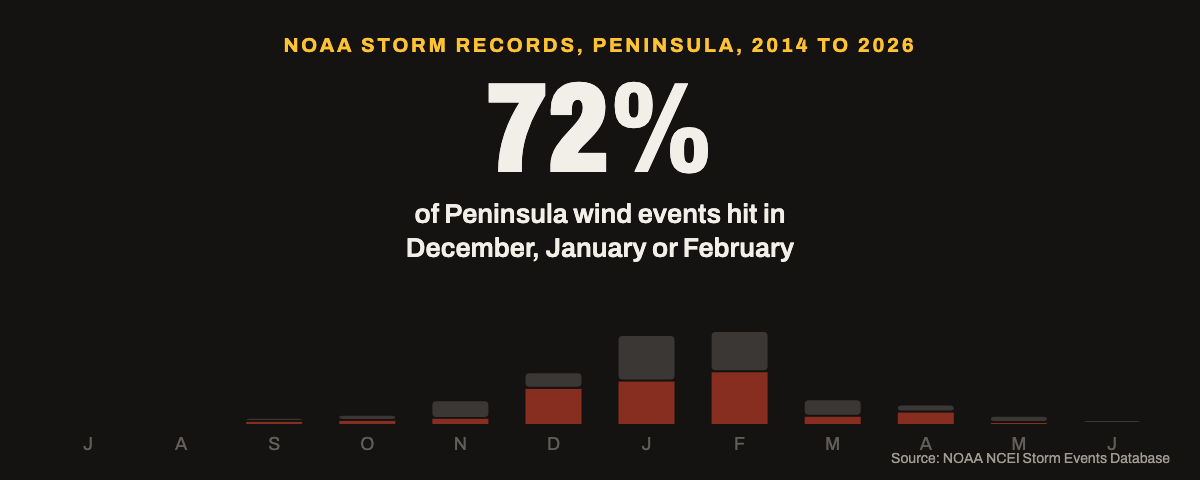
There is a second job to refuse: thinning the canopy “so the wind blows through.” It sounds logical, and it backfires. Stripping the interior branches creates a lion’s tail, with all the weight bunched at the branch tips, which makes limbs more likely to snap in a storm, not less. The branches and twigs you would remove are exactly what help the tree absorb and spread wind energy. If wind is your worry, the fix is an assessment by a pro, not a thinner canopy.
Crown Raising and Defensible Space in Redwood City
Raising the crown, which means removing the lowest branches for clearance, is one of the few larger pruning jobs a coast redwood genuinely benefits from, especially for wildfire defensible space on Peninsula hillside lots. Lifting the lowest limbs reduces the ladder fuels that let a ground fire climb into the canopy, and it opens room around structures. Coast redwoods are naturally fire-resistant, with thick bark and high foliage, but clearance still matters on wooded parcels in places like Emerald Hills and Woodside.
Keep it measured: lift only the lowest limbs you need, and leave the crown itself intact. California’s defensible space rules focus on spacing and clearance, not on gutting a tree, and the same restraint applies here. If you are clearing for fire safety, our overview of defensible space tree clearing walks through the zones, and heavier clearance around a tall redwood is a job for professional tree trimming with the right rigging.
Defensible-space clearance is core work for a firefighter-owned crew, and raising the crown on a tall redwood is one of the jobs we handle most carefully. The goal on a wooded Peninsula lot is always the same: lift only the lowest limbs needed to break the ladder from ground to canopy, keep the crown itself intact, and leave the tree standing as the fire-resistant asset it already is.
When to Call a Professional, and What It Costs
Call a professional for any redwood work that leaves the ground, and expect to pay roughly $500 to $1,500 to prune a single mature redwood, with larger or multi-tree jobs running higher. A mature coast redwood stands 100 to 300 feet tall, and climbing or rigging one is genuinely dangerous work that belongs with insured, ISA-certified arborists, not a homeowner on a ladder. The cost reflects the height, the equipment, and the risk, not just the hours.
You can handle the small stuff yourself: basal sprouts, a low dead branch you can reach from the ground, light clearance on a young tree. Everything above head height, anything near power lines, and any storm-damaged limb should go to a pro. A trained certified arborist in Redwood City can also spot decay, root problems, and hazards you would never see from the ground.
Next steps if you are weighing a prune:
- Confirm the species: green all winter means coast redwood.
- Walk the tree and flag only the dead, broken, or clearance limbs.
- Skip anything that means topping, leader removal, or heavy thinning.
- For work off the ground, get a quote from a licensed local crew.
Do this and you will know exactly what your tree needs, and what it does not, before anyone touches it.
Redwood Pruning Done Right by Firefighter Tree Service
Coast redwoods reward restraint, and the crews that respect that are the ones worth hiring. Firefighter Tree Service is a firefighter-owned, ISA-certified team that has cared for more than 500 residential properties across Redwood City and the Peninsula, and we treat every redwood like the landmark it is. When your tree needs more than a ground-level trim, our redwood pruning in Redwood City service brings the height, the rigging, and the safety, backed by a 3-day service guarantee. Call us at 650-454-0373 to talk through your tree.