
If you own oaks on the Peninsula and you have noticed dark sap bleeding down a trunk, or a canopy that browned out over a single season, Sudden Oak Death is a fair thing to worry about. It has killed millions of California oaks, it has no cure, and the trees most at risk are the coast live oaks growing in Bay Area yards. Here is the more useful truth: not every dying oak has it, prevention genuinely works on healthy trees, and knowing what you are actually looking at changes every decision that comes next.
What Sudden Oak Death Is, and Why It Keeps Killing Bay Area Oaks
Sudden Oak Death is a tree disease caused by Phytophthora ramorum, a water mold that infects the bark of oaks and slowly girdles the trunk from within. Despite the name, it rarely kills quickly. The pathogen can work for months or even years before the crown browns all at once, which is why the death looks sudden even though the infection was not. First identified in Marin County in the mid-1990s, it now runs through coastal California from Big Sur to Humboldt County, and the Peninsula sits squarely inside that zone.
For a homeowner in Redwood City, Emerald Hills, or Woodside, that history matters because it is not slowing down. The disease is established in our hills, and it treats a mature backyard oak the same way it treats a forest one. Sudden Oak Death is also just one of several problems that can bring an oak down, so it helps to understand it alongside the other common tree diseases in the Bay Area.
Which Trees Die, and Which Ones Just Spread It
Sudden Oak Death kills coast live oak and tanoak, while California bay laurel and a few common garden plants carry the pathogen without dying from it. White oaks are naturally resistant. Knowing which category your tree falls into tells you whether you are protecting a target or living next to a source.
| Tree or plant | How it responds to P. ramorum |
|---|---|
| Coast live oak (Quercus agrifolia) | Killed. The most commonly lost species in Peninsula yards. |
| Tanoak (Notholithocarpus densiflorus) | Highly susceptible. Dies at every age, from seedling to mature tree. |
| California black oak, Shreve oak | Susceptible members of the red oak group. |
| Valley oak, blue oak, other white oaks | Naturally resistant. Not killed by the pathogen. |
| California bay laurel (Umbellularia californica) | Carrier. Breeds the pathogen on its leaves and rarely shows harm. |
| Rhododendron, camellia, coast redwood foliage | Can carry the pathogen without dying. |
The important takeaway is that bay laurel often looks perfectly healthy while it is fueling the whole problem. It hosts the pathogen without symptoms, so a green, thriving bay tree next to your oak is not reassuring. It is the warning.
The Warning Signs: Bleeding Cankers and Sudden Crown Browning
The first visible sign of Sudden Oak Death is usually a bleeding canker: a dark reddish-brown to black ooze seeping through otherwise intact bark on the lower trunk. The sap is thick and sticky, and it often carries a fermented, wine-barrel smell. As a rule, only trees more than about 4 inches across show this symptom, and the ooze appears on bark that has not been cut or wounded.
Watch for these signs on your oaks:
- Bleeding cankers: dark sap oozing from unbroken bark on the lower trunk, usually the first clue.
- Darkened inner bark: peel back a small flap near a canker and the tissue looks brown or black instead of pale green.
- Sudden crown browning: foliage shifts from green to pale to brown, sometimes across the whole canopy within weeks.
- Epicormic sprouts: small shoots pushing straight out of the trunk as a stressed tree tries to survive.
- Beetle activity: fine sawdust and tiny bore holes once bark beetles move into a weakened tree, a sign of serious decline.
Is It Sudden Oak Death, or Something Else?
Plenty of dying Bay Area oaks do not have Sudden Oak Death, and no one can confirm the disease just by looking at it. A bleeding or oozing trunk can also come from a girdling root, a tree that was planted too deep, drought stress, bacterial wetwood, or wood-boring beetles such as the gold-spotted oak borer. Each of those has a different cause and a different fix, so guessing wrong wastes money and time the tree may not have.
Here is how the common lookalikes tend to sort out:
- Planted too deep or a girdling root: often a younger oak that never established, with decline focused low on the trunk. This is a planting and structure problem, not a pathogen.
- Drought and heat: browning that shows up in late summer, frequently on the sunniest side, on a tree that was fine in spring.
- Gold-spotted oak borer and bark beetles: D-shaped exit holes, staining, and sawdust, with the insects driving the decline rather than following it.
- Sudden Oak Death: bleeding cankers on intact lower bark, often with a healthy-looking bay laurel nearby, and a crown that browns fast.
The only way to know for certain is a lab test, because the pathogen cannot be identified by symptoms alone. That is where a professional tree health inspection earns its cost: a certified arborist pulls a tissue sample, sends it for culture or DNA analysis, and rules the lookalikes in or out. The immediate payoff is simple. You stop guessing and finally know what you are dealing with, which is the difference between a treatment plan that works and one that was never going to.
Why Bay Laurel Drives the Whole Problem
California bay laurel is the single biggest reason oaks get infected. According to UC Integrated Pest Management, the presence of California bay laurel is the greatest predictor of P. ramorum canker on an oak. The pathogen multiplies on bay leaves, then drips or blows onto oak trunks when it rains. That is why the disease is a wet-season disease: infection happens during the rains, usually in spring, when the pathogen is wet, active, and moving.
This gives you one firm rule for oak care. Prune oaks only in the dry summer months, never during the wet season, because fresh cuts made in the rain are open doors for the pathogen and for the beetles that follow. If you are mapping out your yard’s schedule, our guide to the right time to prune trees walks through the same wet-season logic for the rest of your canopy.
There Is No Cure, but Prevention Actually Works
There is no cure for Sudden Oak Death once a tree is infected, but phosphonate treatment can protect healthy oaks that are still at risk. The California Oak Mortality Task Force notes that Agri-Fos, a phosphonate product, is used as a preventive measure on oaks in areas that are at risk but not yet infested. The catch is timing: it only helps before infection sets in, so it protects the healthy tree standing next to a bay laurel, not the one already bleeding.
| Treatment detail | What to know |
|---|---|
| Timing | Apply in spring or fall, when rainfall can move the product into the tree. |
| Method | Bark spray on the trunk or a soil drench around the root zone. |
| Frequency | Booster treatments every 1 to 2 years for ongoing protection. |
| Best candidates | Healthy, high-value oaks growing within about 50 feet of bay laurel. |
| Will not work on | Trees that already show cankers. Treatment cannot reverse infection. |
Prevention is more than a spray, though. Space and sanitation matter just as much: keep bay laurel away from valued oaks, clean and disinfect pruning tools after working on a suspect tree, and do not move oak firewood, bay leaves, or soil from an infested area. If your oak is a candidate for a preventive program, professional tree disease treatment is the difference between a protected tree and a hopeful one.
Should You Really Remove the Bay Laurel Near Your Oaks?
Removing bay laurel within about 15 feet of a valued oak is one of the most effective moves you can make, but it is not a decision to make with a chainsaw and a bad afternoon. Bay laurel is a native tree with real ecological value, and clear-cutting every one on the property is usually the wrong answer. The goal is targeted: identify the bays that sit closest to the oaks you most want to keep, and thin those.
There is also a limit to what you control. If the source is a neighbor’s bay laurel or an open-space preserve behind your fence, you cannot manage their land, and pushing for a wholesale removal you do not own rarely goes well. In that situation the smarter play is to defend your side of the line: put your at-risk oaks on a phosphonate program, keep your own bays spaced away from them, and monitor closely each spring. A certified arborist can map which bays actually threaten which oaks so you are removing the trees that matter and keeping the ones that do not.
A Dead Oak Is a Fire Hazard, Not Just a Dead Tree
A dead oak on the Peninsula is not only a landscaping problem, it is fuel. As a firefighter-owned crew, we size up a standing dead oak the way we would size up any hazard: dry, brittle wood near a home in a fire-prone region, holding limbs that will come down on their own schedule rather than yours. Sudden Oak Death makes this worse, because secondary fungi and beetles keep breaking down the wood after the tree dies, so a dead oak gets more brittle and less predictable every season it stands.
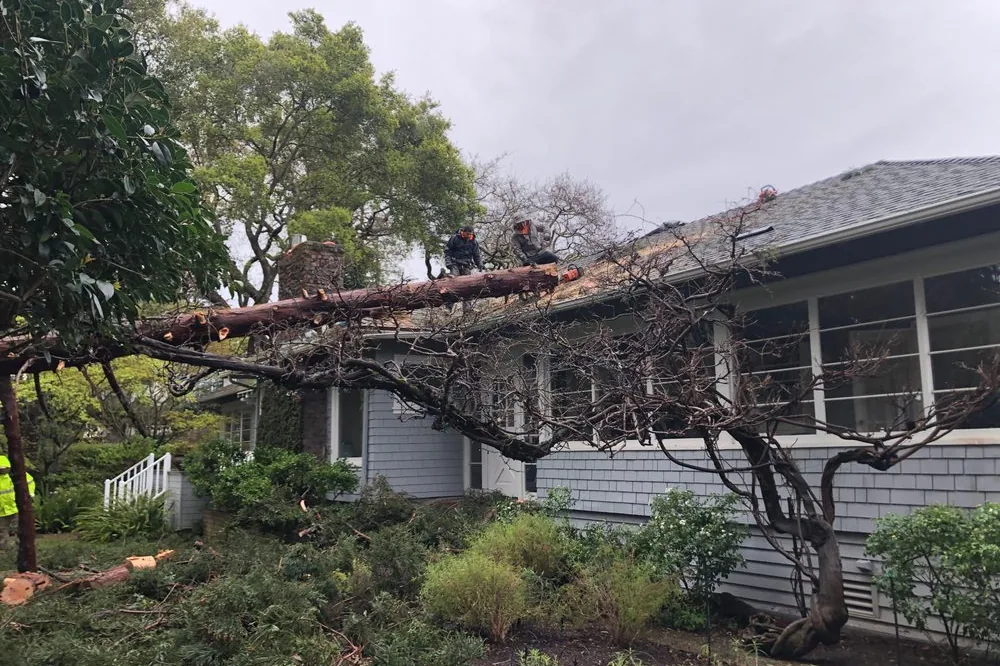
That combination, wildfire fuel plus failing structure, is why a confirmed dead oak near a house, driveway, or power line should not wait. A dead tree in your defensible space works against you the moment embers arrive, and a heavy oak limb over a roof is a year-round liability. When an oak reaches this point, it is worth reviewing the broader signs a tree needs removal and, if it threatens a structure, arranging emergency tree removal before the next storm or fire season does it for you.
Removing dead, hazardous oaks is routine work for our crew. When Sudden Oak Death has killed an oak and left it leaning toward a home or standing inside a property’s defensible space, that is exactly the kind of removal we move to the front of the line. A brittle dead oak near a structure does not get safer while you wait on it, and the fire-prone months are the worst possible time to still have one standing.
When to Call an Arborist
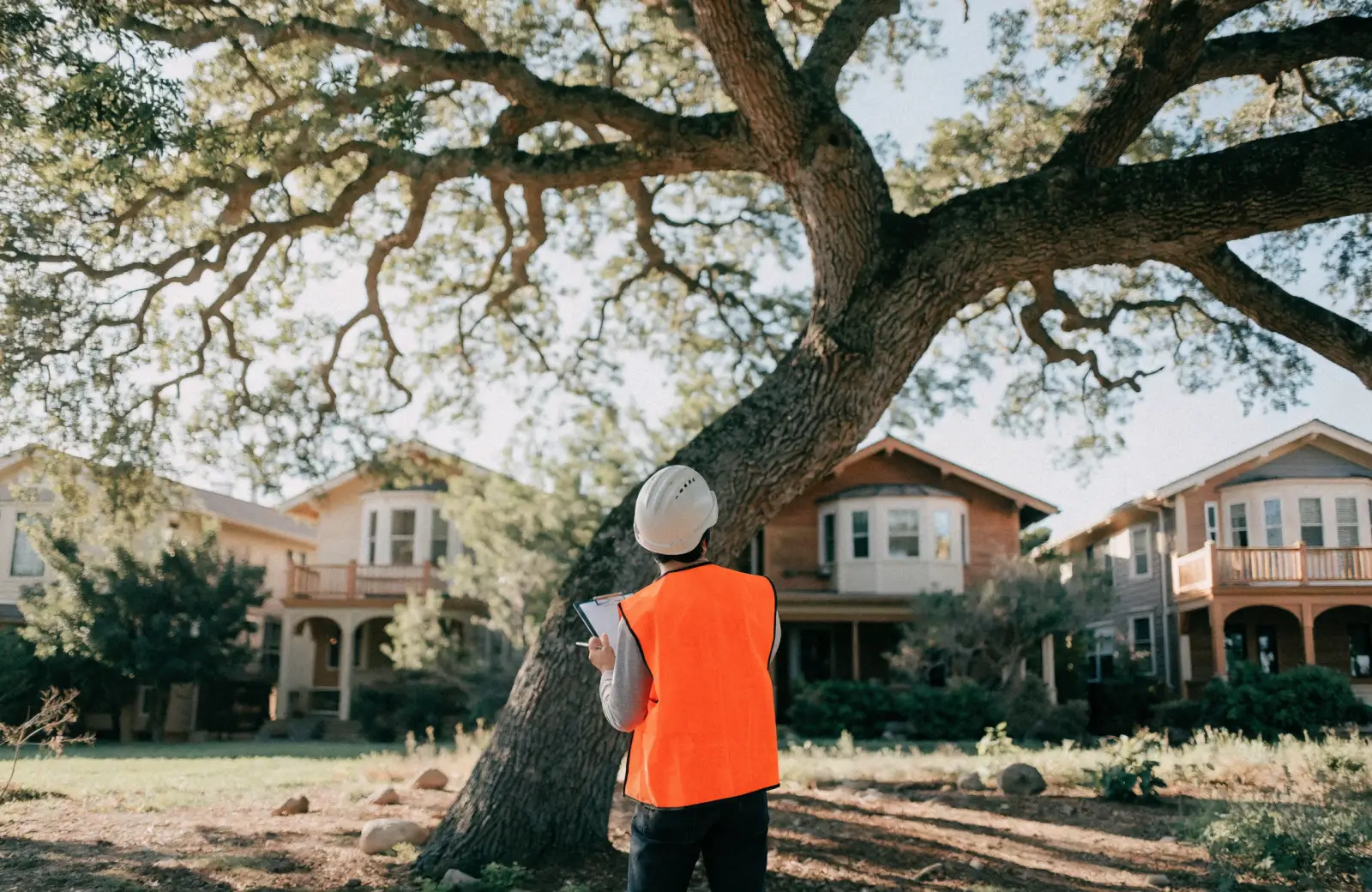
Call a certified arborist as soon as you see bleeding cankers, fast crown browning, or beetle sawdust on an oak, or whenever a dead oak stands near a structure. An ISA Certified Arborist can pull a sample for lab confirmation, judge whether the tree is a structural risk, and tell you honestly whether treatment, monitoring, or removal is the right path. The International Society of Arboriculture publishes guidance on recognizing tree risk that underlines why this is a judgment call for a trained professional, not a homeowner with a hunch.
If you suspect Sudden Oak Death, here is a clean order of operations:
- Photograph the trunk, the bark ooze, and the canopy so you have a baseline to compare against.
- Book a professional inspection and lab test before you spend anything on treatment.
- If the tree is healthy and at risk, start a phosphonate program on the timing above.
- If the tree is confirmed dead or failing, schedule removal on a safety timeline, not a convenient one.
We bring real local experience to this work. Firefighter Tree Service has cared for more than 500 properties across the Peninsula, and oaks are the trees homeowners call us back to more than any other, from preventive treatment on a healthy tree to the safe removal of one that could not be saved.
Protect Your Oaks with Firefighter Tree Service
The oaks on your property are worth protecting, and the earliest action always beats the most dramatic one. A healthy coast live oak shades a home, holds a hillside, and outlives the people who plant it, but only if Sudden Oak Death is caught before it takes hold or handled safely once a tree is lost. Firefighter Tree Service brings ISA-certified arborists and a firefighter’s hazard-first discipline to oak tree care across the Bay Area, from preventive treatment and bay laurel management to the safe removal of a tree that cannot be saved. Call us at (650) 454-0373 to have your oaks assessed before the next wet season starts the cycle again.